Pearson+ LogoPearson+ Logo
Ch.24 Lipid Metabolism
McMurry - Fundamentals of GOB 8th Edition
McMurry8th EditionFundamentals of GOBISBN: 9780134015187Not the one you use?Change textbook
Chapter 24, Problem 53

What causes acetone to be present in the breath of someone with uncontrolled diabetes?

Verified step by step guidance
1
Understand the context: In uncontrolled diabetes, the body cannot effectively use glucose for energy due to insufficient insulin or insulin resistance. As a result, the body turns to alternative energy sources, such as fats, for fuel.
Explain fat metabolism: When fats are broken down for energy, they produce molecules called ketone bodies. These include acetoacetate, beta-hydroxybutyrate, and acetone. This process is called ketosis and occurs when carbohydrate metabolism is impaired.
Describe acetone production: Acetone is a byproduct of the breakdown of acetoacetate, one of the ketone bodies. This reaction occurs spontaneously and releases acetone, which is volatile and can be exhaled through the lungs.
Relate to diabetes: In uncontrolled diabetes, the excessive breakdown of fats leads to an overproduction of ketone bodies, a condition known as ketoacidosis. The high levels of acetone in the blood result in its presence in the breath, giving it a characteristic fruity odor.
Summarize the connection: The presence of acetone in the breath of someone with uncontrolled diabetes is a direct result of the body's shift to fat metabolism and the subsequent overproduction of ketone bodies due to the lack of effective glucose utilization.

Verified video answer for a similar problem:

This video solution was recommended by our tutors as helpful for the problem above.
Video duration:
3m
Was this helpful?

Key Concepts

Here are the essential concepts you must grasp in order to answer the question correctly.

Diabetic Ketoacidosis

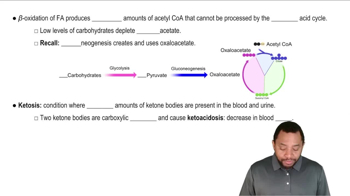
Diabetic ketoacidosis (DKA) is a serious complication of diabetes that occurs when the body starts breaking down fats at an accelerated rate due to insufficient insulin. This process leads to the production of ketones, including acetone, which can accumulate in the blood and be exhaled in the breath, resulting in a characteristic fruity odor.
Recommended video:
Guided course
1:52
Ketone Bodies Concept 3

Ketogenesis

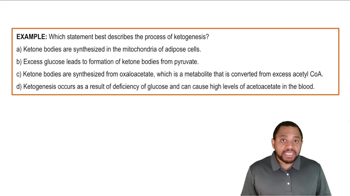
Ketogenesis is the metabolic process through which the liver converts fatty acids into ketone bodies, including acetone, during periods of low carbohydrate availability. In uncontrolled diabetes, the lack of insulin prevents glucose from entering cells, prompting the body to utilize fat for energy, thus increasing ketone production and leading to their presence in the breath.
Recommended video:
Guided course
1:41
Ketone Bodies Example 1

Insulin Deficiency

Insulin deficiency occurs when the body does not produce enough insulin to regulate blood glucose levels effectively. In uncontrolled diabetes, this deficiency leads to elevated blood sugar levels, triggering the body to resort to fat metabolism for energy, which results in the production of ketones, including acetone, that can be detected in the breath.
Recommended video:
Guided course
1:41
Ketone Bodies Example 1