Pearson+ LogoPearson+ Logo
Ch.24 Lipid Metabolism
McMurry - Fundamentals of GOB 8th Edition
McMurry8th EditionFundamentals of GOBISBN: 9780134015187Not the one you use?Change textbook
Chapter 24, Problem 49a

How many molecules of acetyl-CoA result from complete catabolism of the following compounds?
a. Myristic acid, CH3(CH2)12COOH

Verified step by step guidance
1
Identify the structure of myristic acid: Myristic acid is a saturated fatty acid with the formula CH₃(CH₂)₁₂COOH. It contains 14 carbon atoms in total (1 from CH₃, 12 from CH₂ groups, and 1 from the carboxylic acid group).
Understand the process of beta-oxidation: Beta-oxidation is the metabolic pathway that breaks down fatty acids into acetyl-CoA molecules. Each cycle of beta-oxidation removes a 2-carbon unit (as acetyl-CoA) from the fatty acid chain.
Determine the number of beta-oxidation cycles: Since myristic acid has 14 carbon atoms, divide the total number of carbons by 2 to determine the number of acetyl-CoA molecules produced. This gives 14 ÷ 2 = 7 acetyl-CoA molecules.
Account for the number of beta-oxidation cycles: The number of beta-oxidation cycles required to completely break down the fatty acid is one less than the number of acetyl-CoA molecules produced. For myristic acid, this would be 7 - 1 = 6 cycles.
Summarize the result: The complete catabolism of myristic acid through beta-oxidation produces 7 molecules of acetyl-CoA. Each acetyl-CoA can then enter the citric acid cycle for further energy production.

Verified video answer for a similar problem:

This video solution was recommended by our tutors as helpful for the problem above.
Video duration:
1m
Was this helpful?

Key Concepts

Here are the essential concepts you must grasp in order to answer the question correctly.

Beta-Oxidation

Beta-oxidation is the metabolic process by which fatty acids are broken down in the mitochondria to generate acetyl-CoA. Each cycle of beta-oxidation shortens the fatty acid chain by two carbon atoms, producing one molecule of acetyl-CoA, along with NADH and FADH2, which are used in the electron transport chain for ATP production.
Recommended video:
Guided course
01:26
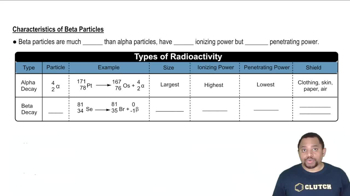
Beta Decay Example 1

Fatty Acid Structure

Fatty acids are long hydrocarbon chains with a carboxylic acid group at one end. The number of carbon atoms in the fatty acid determines how many cycles of beta-oxidation will occur. For example, myristic acid has 14 carbon atoms, which influences the total number of acetyl-CoA molecules produced during its complete catabolism.
Recommended video:
Guided course
0:55
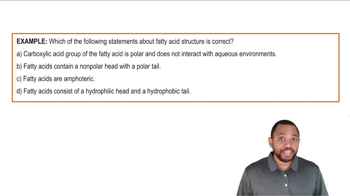
Fatty Acids Example 1

Acetyl-CoA Production

Acetyl-CoA is a key metabolic intermediate that enters the citric acid cycle (Krebs cycle) for energy production. Each complete cycle of beta-oxidation of a fatty acid yields one acetyl-CoA molecule, and the total number of acetyl-CoA molecules produced can be calculated by dividing the total number of carbon atoms in the fatty acid by two.
Recommended video:
Guided course
01:37
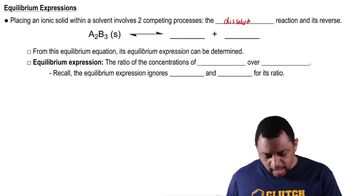
Solubility Product Constant (Ksp) Concept 2