Pearson+ LogoPearson+ Logo
Ch.25 Protein and Amino Acid Metabolism
McMurry - Fundamentals of GOB 8th Edition
McMurry8th EditionFundamentals of GOBISBN: 9780134015187Not the one you use?Change textbook
Chapter 25, Problem 33

From what two amino acids do the nitrogens in urea arise?
<IMAGE>

Verified step by step guidance
1
Understand the context: Urea is a waste product formed in the liver during the urea cycle, which is a process that removes excess nitrogen from the body. The nitrogens in urea originate from specific amino acids during this cycle.
Recall the urea cycle: The urea cycle involves the conversion of ammonia (NH₃) and aspartate into urea. Ammonia is derived from the deamination of amino acids, while aspartate contributes its nitrogen directly to the urea molecule.
Identify the amino acids: The two amino acids that contribute nitrogen to urea are glutamate and aspartate. Glutamate provides nitrogen through the release of ammonia during oxidative deamination, and aspartate donates its nitrogen directly in the cycle.
Relate to Figure 25.3: If you refer to Figure 25.3 in your textbook, it likely illustrates the urea cycle and highlights the roles of glutamate and aspartate in nitrogen donation.
Summarize the answer: The nitrogens in urea arise from glutamate (via ammonia) and aspartate, as these are the key contributors of nitrogen in the urea cycle.

Verified video answer for a similar problem:

This video solution was recommended by our tutors as helpful for the problem above.
Video duration:
3m
Was this helpful?

Key Concepts

Here are the essential concepts you must grasp in order to answer the question correctly.

Amino Acids

Amino acids are organic compounds that serve as the building blocks of proteins. They contain an amino group, a carboxyl group, and a unique side chain. In the context of urea synthesis, specific amino acids contribute their nitrogen atoms, which are crucial for the formation of urea in the liver during the urea cycle.
Recommended video:
Guided course
3:03
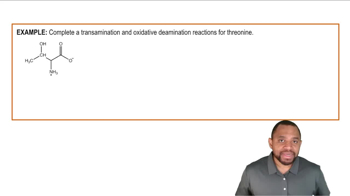
Amino Acid Catabolism: Amino Group Example 2

Urea Cycle

The urea cycle is a series of biochemical reactions that convert ammonia, a toxic byproduct of protein metabolism, into urea, which is excreted in urine. This cycle primarily occurs in the liver and involves several enzymes and intermediates. Understanding this cycle is essential for identifying the sources of nitrogen in urea, particularly from amino acids.
Recommended video:
Guided course
0:51
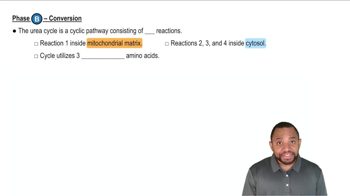
The Urea Cycle Concept 3

Nitrogen Sources in Urea

In the urea cycle, the nitrogens in urea primarily originate from the amino acids aspartate and glutamate. Aspartate donates one nitrogen atom, while the other nitrogen comes from ammonia, which is derived from the deamination of glutamate. Recognizing these specific amino acids is key to answering questions about nitrogen metabolism and urea formation.
Recommended video:
Guided course
2:43
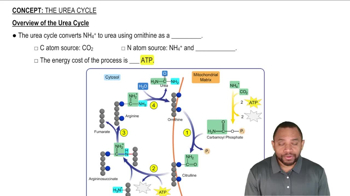
The Urea Cycle Concept 1