Pearson+ LogoPearson+ Logo
Ch.26 Nucleic Acids and Protein Synthesis
McMurry - Fundamentals of GOB 8th Edition
McMurry8th EditionFundamentals of GOBISBN: 9780134015187Not the one you use?Change textbook
Chapter 26, Problem 39

Are polynucleotides synthesized 3′ to 5′ or 5′ to 3′?

Verified step by step guidance
1
Polynucleotides, such as DNA and RNA, are synthesized in the 5′ to 3′ direction. This refers to the orientation of the sugar-phosphate backbone in the nucleotide chain.
The 5′ end of a nucleotide contains a phosphate group attached to the 5′ carbon of the sugar, while the 3′ end contains a hydroxyl (-OH) group attached to the 3′ carbon of the sugar.
During synthesis, the enzyme (e.g., DNA polymerase or RNA polymerase) catalyzes the formation of a phosphodiester bond between the 3′ hydroxyl group of the growing chain and the 5′ phosphate group of the incoming nucleotide.
This process ensures that the chain elongates by adding nucleotides to the 3′ end, maintaining the 5′ to 3′ directionality.
Understanding this directionality is crucial for interpreting processes like DNA replication, transcription, and the synthesis of complementary strands.

Verified video answer for a similar problem:

This video solution was recommended by our tutors as helpful for the problem above.
Video duration:
1m
Was this helpful?

Key Concepts

Here are the essential concepts you must grasp in order to answer the question correctly.

Directionality of Polynucleotide Synthesis

Polynucleotides, such as DNA and RNA, are synthesized in a specific direction, which is 5′ to 3′. This means that nucleotides are added to the 3′ end of the growing chain, allowing the 5′ phosphate group of the incoming nucleotide to bond with the 3′ hydroxyl group of the last nucleotide in the chain.
Recommended video:
Guided course
1:54
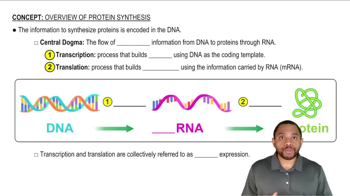
Overview of Protein Synthesis Concept 1

Role of DNA and RNA Polymerases

DNA and RNA polymerases are enzymes responsible for synthesizing polynucleotides. They catalyze the formation of phosphodiester bonds between nucleotides, ensuring that the new strand is built in the 5′ to 3′ direction, which is crucial for accurate replication and transcription processes.
Recommended video:
Guided course
2:43
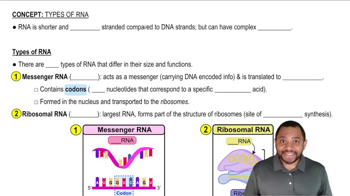
Types of RNA Concept 1

Implications of Synthesis Direction

The 5′ to 3′ synthesis direction has significant implications for biological processes, including DNA replication and RNA transcription. It affects how strands are paired and how enzymes function, leading to the necessity of mechanisms like Okazaki fragments during lagging strand synthesis in DNA replication.
Recommended video:
Guided course
1:54
Overview of Protein Synthesis Concept 1