Draw the structures of adenine and uracil (which replaces thymine in RNA), and show the hydrogen bonding that occurs between them.
Ch.26 Nucleic Acids and Protein Synthesis
Chapter 26, Problem 12
What are Okazaki fragments? What role do they serve in DNA metabolism?
Verified step by step guidance1
Okazaki fragments are short sequences of DNA nucleotides (typically 100-200 nucleotides in eukaryotes and 1000-2000 in prokaryotes) that are synthesized discontinuously during DNA replication on the lagging strand.
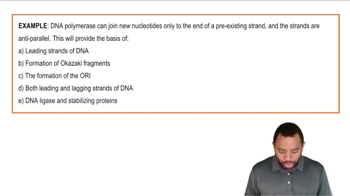
DNA replication is semi-conservative and occurs in the 5' to 3' direction. Since the two strands of DNA are antiparallel, the leading strand is synthesized continuously, while the lagging strand is synthesized in short, discontinuous segments called Okazaki fragments.
The role of Okazaki fragments is to enable the replication of the lagging strand, which cannot be synthesized continuously due to the antiparallel nature of DNA and the unidirectional activity of DNA polymerase.
Once the Okazaki fragments are synthesized, an enzyme called DNA ligase joins these fragments together by forming phosphodiester bonds, creating a continuous DNA strand.
In summary, Okazaki fragments are essential for the accurate and complete replication of the lagging strand, ensuring that the entire DNA molecule is duplicated during cell division.

Verified video answer for a similar problem:
This video solution was recommended by our tutors as helpful for the problem above.
Video duration:
3mWas this helpful?
Key Concepts
Here are the essential concepts you must grasp in order to answer the question correctly.
Okazaki Fragments
Okazaki fragments are short sequences of DNA, typically ranging from 100 to 200 nucleotides in eukaryotes, that are synthesized on the lagging strand during DNA replication. They are formed because DNA polymerase can only synthesize DNA in the 5' to 3' direction, necessitating the creation of these fragments as the replication fork opens up.
Recommended video:
Guided course
Steps of DNA Replication Example 1
DNA Replication
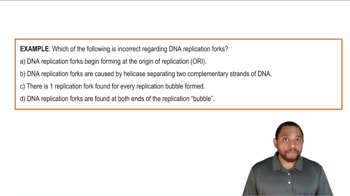
DNA replication is the biological process by which a cell duplicates its DNA, ensuring that each daughter cell receives an exact copy of the genetic material. This process involves unwinding the double helix, synthesizing new strands, and requires various enzymes, including DNA polymerases, helicases, and ligases, to facilitate the accurate and efficient copying of DNA.
Recommended video:
Guided course
Intro to DNA Replication Example 2
Lagging Strand
The lagging strand is one of the two strands of DNA being replicated during DNA synthesis. It is synthesized discontinuously in short segments (Okazaki fragments) because it runs in the opposite direction to the replication fork movement. This results in a more complex synthesis process compared to the leading strand, which is synthesized continuously.
Recommended video:
Guided course
Steps of DNA Replication Example 1
Related Practice
Textbook Question
851
views
Textbook Question
Is a DNA molecule neutral, negatively charged, or positively charged? Explain.
1040
views
Textbook Question
DNA and RNA, like proteins, can be denatured to produce unfolded or uncoiled strands. Heating DNA to what is referred to as its “melting temperature” denatures it (the two strands of the double helix become separated). Why does a longer strand of DNA have a higher melting temperature than a shorter one?
690
views
Textbook Question
What is the difference between DNA polymerase and DNA ligase?
833
views
Textbook Question
What is the function of the spliceosome in hnRNA?
1410
views
Textbook Question
What mRNA base sequences are complementary to the following DNA template sequences? Be sure to label the 5′ and 3′ ends of the complementary sequences.
a. 5′ CAT GCT CTA CAG 3′
1272
views