Pearson+ LogoPearson+ Logo
Ch.26 Nucleic Acids and Protein Synthesis
McMurry - Fundamentals of GOB 8th Edition
McMurry8th EditionFundamentals of GOBISBN: 9780134015187Not the one you use?Change textbook
Chapter 26, Problem 27a

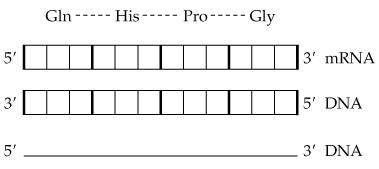
Gln-His-Pro-Gly is the sequence of a molecule known as progenitor thyrotropin-releasing hormone (pro-TRH). If we were searching for pro-TRH genes, we would need to know what sequence of bases in DNA we should be looking for. Use the following boxes to indicate answers to parts (a)–(d).

a. What RNA sequence could code for these four amino acids?

Verified step by step guidance
1
Step 1: Understand the relationship between amino acids and their corresponding RNA codons. Each amino acid is coded by a specific set of three RNA bases called a codon. For example, glutamine (Gln) is coded by codons such as CAA or CAG.
Step 2: Identify the RNA codons for each amino acid in the sequence Gln-His-Pro-Gly. Use a codon table to find the possible RNA codons for each amino acid: Gln (CAA or CAG), His (CAU or CAC), Pro (CCU, CCC, CCA, or CCG), and Gly (GGU, GGC, GGA, or GGG).
Step 3: Choose one codon for each amino acid to construct the RNA sequence. For example, you might select CAA for Gln, CAU for His, CCU for Pro, and GGU for Gly. This gives you a possible RNA sequence: CAA-CAU-CCU-GGU.
Step 4: Remember that RNA uses uracil (U) instead of thymine (T), which is found in DNA. Ensure that all codons in your RNA sequence contain U instead of T.
Step 5: Verify the RNA sequence by cross-checking with the codon table to ensure that each codon corresponds correctly to the amino acids in the sequence Gln-His-Pro-Gly.

Verified video answer for a similar problem:

This video solution was recommended by our tutors as helpful for the problem above.
Video duration:
2m
Was this helpful?

Key Concepts

Here are the essential concepts you must grasp in order to answer the question correctly.

Genetic Code

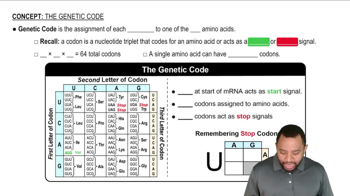
The genetic code is a set of rules that defines how the sequence of nucleotides in DNA and RNA is translated into the sequence of amino acids in proteins. Each amino acid is encoded by a specific sequence of three nucleotides, known as a codon. Understanding the genetic code is essential for determining which RNA sequences correspond to specific amino acid sequences, such as the one provided for pro-TRH.
Recommended video:
Guided course
03:25
The Genetic Code Concept 1

Transcription and Translation

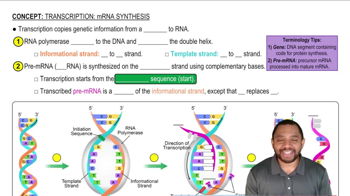
Transcription is the process by which the information in a DNA sequence is copied into a complementary RNA sequence. Translation is the subsequent process where the RNA sequence is read by ribosomes to synthesize proteins. Knowledge of these processes is crucial for identifying the RNA sequence that would code for the amino acids in the pro-TRH molecule.
Recommended video:
Guided course
6:37
Transcription: mRNA Synthesis Concept 1

Amino Acid Sequence

An amino acid sequence is the order of amino acids in a protein, which determines its structure and function. The sequence Gln-His-Pro-Gly corresponds to specific codons in mRNA, which must be identified to find the corresponding DNA sequence. Recognizing how amino acids relate to their codons is vital for answering the question about the RNA sequence coding for pro-TRH.
Recommended video:
Guided course
3:03
Amino Acid Catabolism: Amino Group Example 2