Pearson+ LogoPearson+ Logo
Ch.26 Nucleic Acids and Protein Synthesis
McMurry - Fundamentals of GOB 8th Edition
McMurry8th EditionFundamentals of GOBISBN: 9780134015187Not the one you use?Change textbook
Chapter 26, Problem 18a

What amino acids do the following sequences code for?
a. AUC

Verified step by step guidance
1
Step 1: Recognize that the question involves translating a codon sequence into its corresponding amino acid. This process is part of the central dogma of molecular biology, where mRNA codons are translated into amino acids using the genetic code.
Step 2: Identify the codon provided in the sequence. In this case, the codon is 'AUC'.
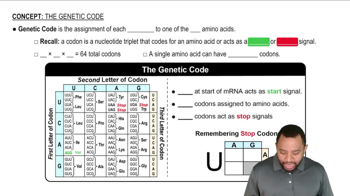
Step 3: Recall that codons are three-nucleotide sequences in mRNA that correspond to specific amino acids. Use the standard genetic code table to determine the amino acid for the codon 'AUC'.
Step 4: Look up 'AUC' in the genetic code table. The codon 'AUC' corresponds to the amino acid isoleucine (Ile).
Step 5: Conclude that the sequence 'AUC' codes for the amino acid isoleucine. Note that this process assumes the sequence is part of an mRNA strand and follows the standard genetic code.

Verified video answer for a similar problem:

This video solution was recommended by our tutors as helpful for the problem above.
Video duration:
27s
Was this helpful?

Key Concepts

Here are the essential concepts you must grasp in order to answer the question correctly.

Amino Acids

Amino acids are organic compounds that serve as the building blocks of proteins. There are 20 standard amino acids, each with a unique side chain that determines its properties and role in protein structure and function. Understanding which amino acids correspond to specific codons is essential for interpreting genetic sequences.
Recommended video:
Guided course
3:03
Amino Acid Catabolism: Amino Group Example 2

Codons

Codons are sequences of three nucleotides in mRNA that correspond to specific amino acids or stop signals during protein synthesis. The genetic code is universal, meaning that the same codons specify the same amino acids across different organisms. For example, the codon AUC codes for the amino acid isoleucine.
Recommended video:
Guided course
03:25
The Genetic Code Concept 1

Genetic Code

The genetic code is a set of rules that defines how sequences of nucleotides in DNA and RNA are translated into amino acids. It consists of 64 possible codons, with 61 coding for amino acids and 3 serving as stop signals. Familiarity with the genetic code is crucial for decoding mRNA sequences and understanding protein synthesis.
Recommended video:
Guided course
03:25
The Genetic Code Concept 1