Pearson+ LogoPearson+ Logo
Ch.26 Nucleic Acids and Protein Synthesis
McMurry - Fundamentals of GOB 8th Edition
McMurry8th EditionFundamentals of GOBISBN: 9780134015187Not the one you use?Change textbook
Chapter 26, Problem 15a

What mRNA base sequences are complementary to the following DNA template sequences? Be sure to label the 5′ and 3′ ends of the complementary sequences.
a. 5′ CAT GCT CTA CAG 3′

Verified step by step guidance
1
Identify the base-pairing rules between DNA and RNA. In RNA, adenine (A) pairs with uracil (U), thymine (T) pairs with adenine (A), cytosine (C) pairs with guanine (G), and guanine (G) pairs with cytosine (C).
Write the DNA template sequence provided in the problem: 5′ CAT GCT CTA CAG 3′.
Determine the complementary RNA sequence by applying the base-pairing rules to each base in the DNA template. For example, C in DNA pairs with G in RNA, A in DNA pairs with U in RNA, and so on.
Reverse the direction of the complementary RNA sequence to ensure it is written in the correct 5′ to 3′ orientation, as RNA is synthesized in this direction.
Label the 5′ and 3′ ends of the complementary RNA sequence to clearly indicate its orientation.

Verified video answer for a similar problem:

This video solution was recommended by our tutors as helpful for the problem above.
Video duration:
1m
Was this helpful?

Key Concepts

Here are the essential concepts you must grasp in order to answer the question correctly.

DNA and RNA Structure

DNA and RNA are nucleic acids composed of nucleotide sequences. DNA is double-stranded and contains the bases adenine (A), thymine (T), cytosine (C), and guanine (G). In contrast, RNA is typically single-stranded and contains uracil (U) instead of thymine. Understanding the structural differences is crucial for determining how base pairing occurs during transcription.
Recommended video:
Guided course
2:43
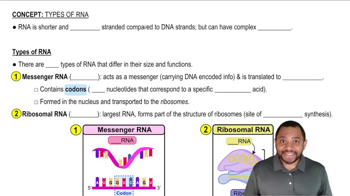
Types of RNA Concept 1

Base Pairing Rules

Base pairing rules dictate how nucleotides pair between DNA and RNA. In DNA, adenine pairs with thymine, and cytosine pairs with guanine. During transcription, the complementary RNA sequence is formed by pairing adenine with uracil and cytosine with guanine. Knowing these rules is essential for accurately determining the mRNA sequence from a given DNA template.
Recommended video:
Guided course
2:01
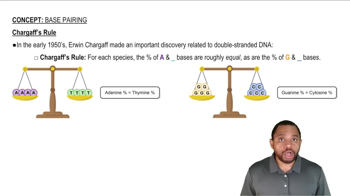
Base Pairing Concept 2

5′ and 3′ Ends

The 5′ and 3′ ends of nucleic acid strands refer to the orientation of the sugar-phosphate backbone. The 5′ end has a phosphate group attached, while the 3′ end has a hydroxyl group. This directional notation is important in molecular biology, as it affects how nucleic acids are synthesized and how they interact during processes like transcription and translation.
Recommended video:
Guided course
1:43
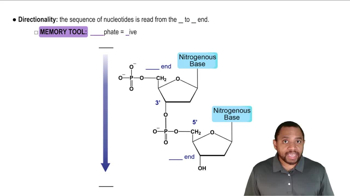
Primary Structure of Nucleic Acids Concept 2