Pearson+ LogoPearson+ Logo
Ch.4 Atoms and Elements
Timberlake - Chemistry: An Introduction to General, Organic, and Biological Chemistry 14th Edition
Timberlake14thChemistry: An Introduction to General, Organic, and Biological ChemistryISBN: 9781292472249Not the one you use?Change textbook
Chapter 4, Problem 16b

Juan added the following elements to the soil to improve potato production. Identify the group and period for and classify each as an alkali metal, an alkaline earth metal, a transition element, or a nonmetal:
b. Cu

Verified step by step guidance
1
Step 1: Begin by identifying the element Cu. Cu is the chemical symbol for copper.
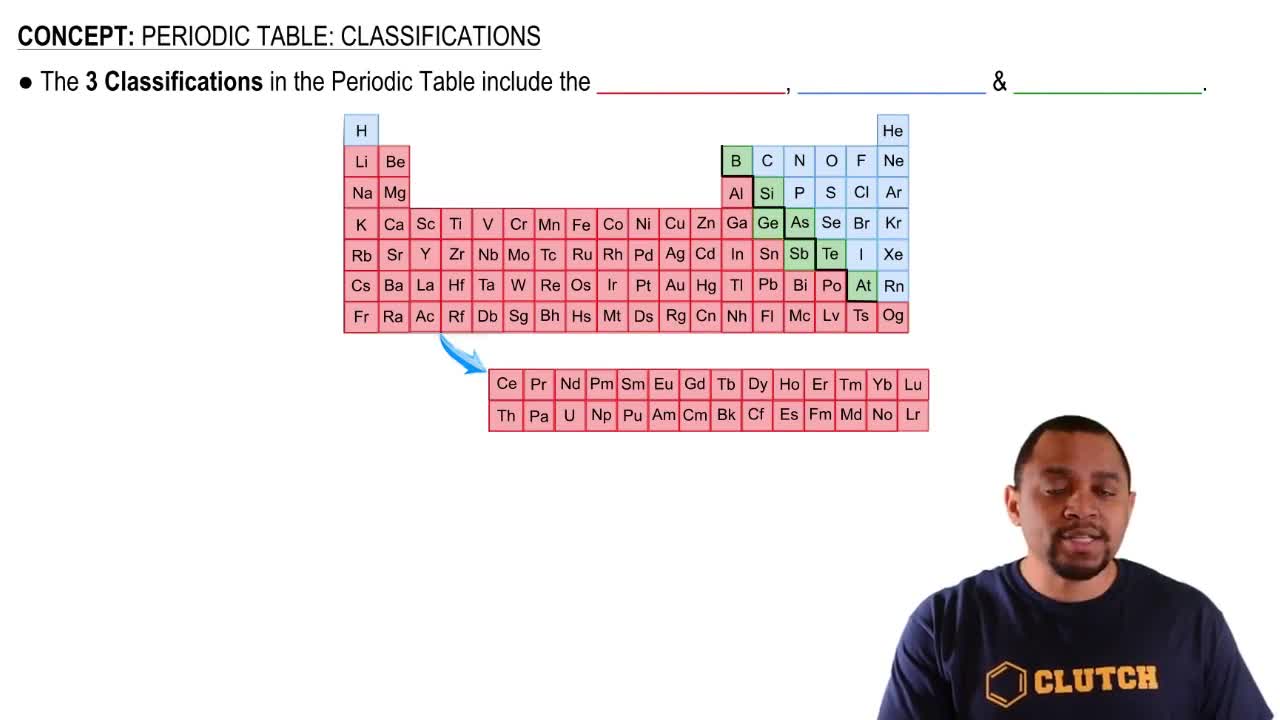
Step 2: Locate copper (Cu) on the periodic table. Copper is found in Group 11 and Period 4.
Step 3: Determine the classification of copper based on its position in the periodic table. Copper is a transition element because it is located in the d-block of the periodic table.
Step 4: Recall that transition elements are metals that have partially filled d orbitals and are known for their ability to form colorful compounds and variable oxidation states.
Step 5: Summarize the findings: Copper (Cu) is a transition element located in Group 11 and Period 4 of the periodic table.

Verified video answer for a similar problem:

This video solution was recommended by our tutors as helpful for the problem above.
Video duration:
1m
Was this helpful?

Key Concepts

Here are the essential concepts you must grasp in order to answer the question correctly.

Periodic Table

The Periodic Table is a systematic arrangement of chemical elements, organized by increasing atomic number. Elements are grouped into columns called groups, which share similar chemical properties, and rows called periods, which indicate the number of electron shells. Understanding the layout of the Periodic Table is essential for classifying elements like copper (Cu) and determining their properties.
Recommended video:
Guided course
02:40
Periodic Table: Classifications

Element Classification

Elements are classified into categories based on their properties. Alkali metals (Group 1) are highly reactive, alkaline earth metals (Group 2) are somewhat reactive, transition metals (Groups 3-12) are characterized by their ability to form various oxidation states, and nonmetals have diverse properties and are generally poor conductors of heat and electricity. Knowing these classifications helps in identifying the nature of elements like copper.
Recommended video:
Guided course
04:19
Classification of Matter

Copper (Cu)

Copper (Cu) is a transition metal located in Group 11 of the Periodic Table. It is known for its excellent electrical conductivity, malleability, and resistance to corrosion. As a transition element, copper can form various oxidation states, which allows it to participate in a wide range of chemical reactions, making it vital for agricultural applications such as improving soil for potato production.
Recommended video:
Guided course
01:23
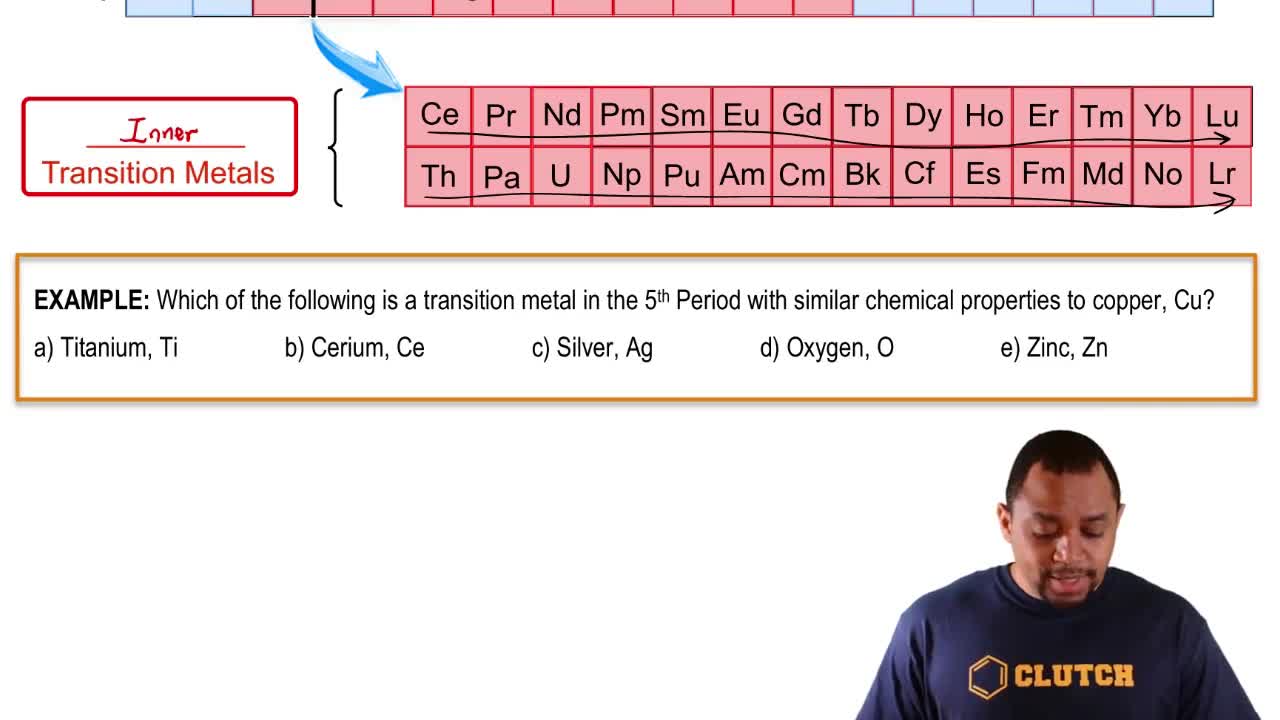
Periodic Table: Representative Elements & Transition Metals Example 1