Indietro
 Klug 10th EditionCh. 8 - Genetic Analysis and Mapping in Bacteria and Bacteriophages
Problema 1a
How do we know that bacteria undergo genetic recombination, allowing the transfer of genes from one organism to another?
Problema 1b
How do we know whether or not genetic recombination between bacteria involves cell-to-cell contact?
Problema 1c
In this chapter, we have focused on genetic systems present in bacteria and the viruses that use bacteria as hosts (bacteriophages). In particular, we discussed mechanisms by which bacteria and their phages undergo genetic recombination, the basis of chromosome mapping. Based on your knowledge of these topics, answer several fundamental questions:
How do we know that during transduction bacterial cell-to-cell contact is not essential?
Problema 2
Write a short summary that contrasts how recombination occurs in bacteria and bacteriophages.
Problema 3
Distinguish among the three modes of recombination in bacteria.
Problema 4a
With respect to F⁺ and F⁻ bacterial matings, answer the following questions: How was it established that physical contact between cells was necessary?
Problema 4b
With respect to F⁺ and F⁻ bacterial matings, answer the following questions: How was it established that chromosome transfer was unidirectional?
Problema 4c
With respect to F⁺ and F⁻ bacterial matings, answer the following questions: What is the genetic basis for a bacterium's being F⁺.
Problema 5
List all major differences between:
(a) The F⁺ x F⁻ and the Hfr x F⁻ bacterial crosses
(b) The F⁺, F⁻, Hfr, and F' bacteria.
Problema 6
Describe the basis for chromosome mapping in the Hfr x F⁻ crosses.
Problema 7
Why are the recombinants produced from an Hfr x F⁻ cross rarely, if ever, F⁺?
Problema 8
Describe the origin of F' bacteria and merozygotes.
Problema 9
Describe the mechanism of transformation.
Problema 10
The bacteriophage genome consists of many genes encoding proteins that make up the head, collar, tail, and tail fibers. When these genes are transcribed following phage infection, how are these proteins synthesized, since the phage genome lacks genes essential to ribosome structure?
Problema 11
Describe the temporal sequence of the bacteriophage life cycle.
Problema 12
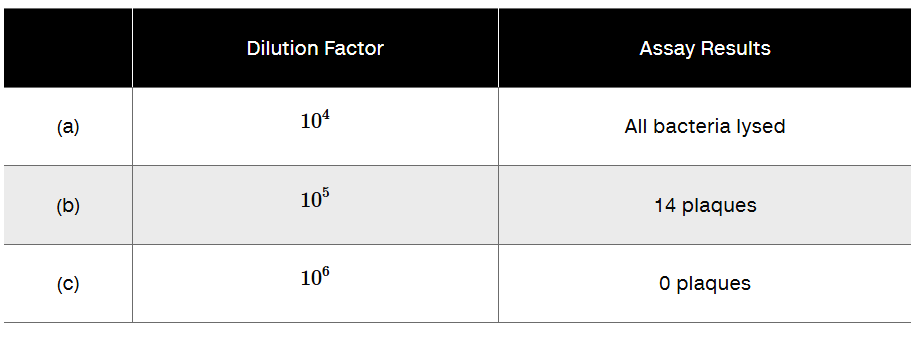
In the plaque assay, what is the precise origin of a single plaque?
Problema 13
In the plaque assay, exactly what makes up a single plaque?
Problema 14
A plaque assay is performed beginning with 1 mL of a solution containing bacteriophages. This solution is serially diluted three times by combining 0.1 mL of each sequential dilution with 9.9 mL of liquid medium. Then 0.1 mL of the final dilution is plated in the plaque assay and yields 17 plaques. What is the initial density of bacteriophages in the original 1 mL?
Problema 15
Describe the difference between the lytic cycle and lysogeny when bacteriophage infection occurs.
Problema 16
Define plaque, lysogeny, and prophage.
Problema 17
Explain the observations that led Zinder and Lederberg to conclude that the prototrophs recovered in their transduction experiments were not the result of F⁺ mediated conjugation.
Problema 18
Describe the execution of and rationale behind linkage and mapping studies of bacterial genes during transduction experiments.
Problema 19
If a single bacteriophage infects one E. coli cell present on a lawn of bacteria and, upon lysis, yields 200 viable viruses, how many phages will exist in a single plaque if three more lytic cycles occur?
Problema 20
If a single bacteriophage infects one E. coli cell present on a lawn of bacteria and, upon lysis, yields 200 viable viruses, how many phages will exist in a single plaque if three more lytic cycles occur?