Indietro
Problema 55a
What is the ATP energy yield associated with each of the following?
a. NADH → NAD+
Problema 55c
What is the ATP energy yield associated with each of the following?
c. 2 pyruvate → 2 acetyl CoA + 2CO2
Problema 56a
What is the ATP energy yield associated with each of the following?
a. FADH2 → FAD
Problema 57a
Caprylic acid, CH3 ― (CH2)6 ― COOH, is a C8 fatty acid found in milk.
a. State the number of β oxidation cycles for the complete oxidation of caprylic acid.
Problema 58a
Lignoceric acid, CH3 ― (CH2)22 ― COOH, is a C24 fatty acid found in peanut oil in small amounts.
a. State the number of β oxidation cycles for the complete oxidation of lignoceric acid.
Problema 59a
Consider the complete oxidation of oleic acid, CH3 ― (CH2)7 ― CH = CH ― (CH2)7 ― COOH, which is a C18 monounsaturated fatty acid.
a. How many cycles of β oxidation are needed?
Problema 60a
Consider the complete oxidation of palmitoleic acid, CH3 ― (CH2)5 ― CH = CH ― (CH2)7 ― COOH, which is a C16 monounsaturated fatty acid found in animal and vegetable oils..
a. How many cycles of β oxidation are needed?
Problema 63
What are some conditions that characterize ketosis?
Problema 65a
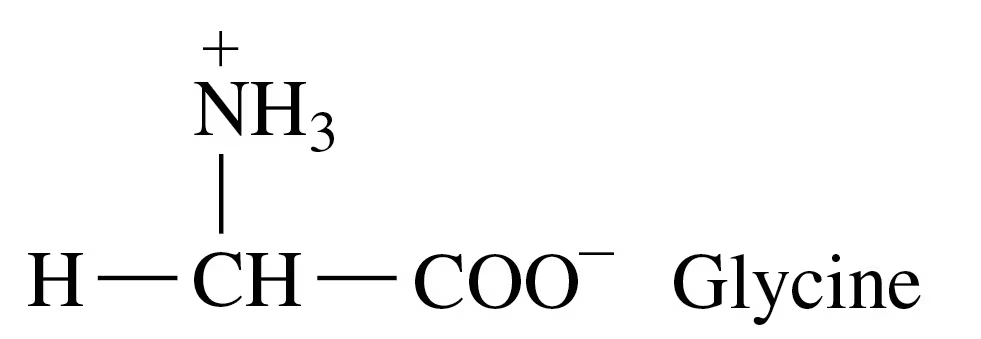
Draw the condensed structural formula for the α-keto acid produced from each of the following in transamination:
a.
Problema 67
Why does the body convert NH4+ to urea?
Problema 68
Draw the condensed structural formula for urea.
Problema 69c
What metabolic substrate(s) are produced from the carbon atoms of each of the following amino acids?
c. tyrosine
Problema 70b
What metabolic substrate(s) are produced from the carbon atoms of each of the following amino acids?
b. asparagine
Problema 72
Draw the condensed structural formulas for the products of the reaction of aspartate and α-ketoglutarate which is catalyzed by aspartate transaminase (AST).
Problema 74a
Arachidic acid is a C20 fatty acid found in peanut and fish oils.
a. How many cycles of β oxidation are needed for the complete oxidation of arachidic acid?
Problema 74c
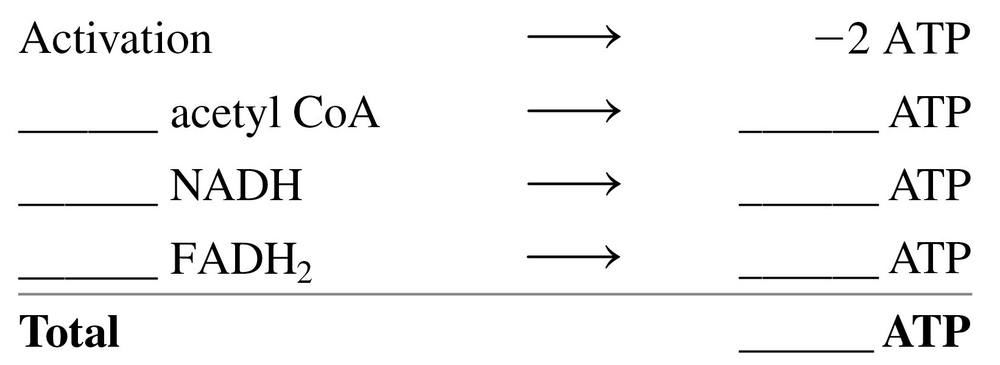
Arachidic acid is a C20 fatty acid found in peanut and fish oils.
c. Calculate the total ATP yield from the complete β oxidation of arachidic acid by completing the following:
Problema 75d
Identify the type of food as carbohydrate, fat, or protein that gives each of the following digestion products:
d. glycerol
Problema 75e
Identify the type of food as carbohydrate, fat, or protein that gives each of the following digestion products:
e. amino acids
Problema 76a
Identify each of the following as a six-carbon or a three-carbon compound and arrange them in the order in which they occur in glycolysis:
a. 3-phosphoglycerate
Problema 83
When is pyruvate converted to lactate in the body?
Problema 84
When pyruvate is used to form acetyl CoA, the product has only two carbon atoms. What happened to the third carbon?
Problema 87
If there are no reactions in the citric acid cycle that use oxygen, O2, why does the cycle operate only in aerobic conditions?
Problema 89
In the chemiosmotic model, how is energy provided to synthesize ATP?
Problema 92a
What metabolic substrate(s) can be produced from the carbon atoms of each of the following amino acids?
a. histidine
Problema 92d
What metabolic substrate(s) can be produced from the carbon atoms of each of the following amino acids?
d. phenylalanine
Problema 93b
One cell at work may break down 2 million (2 000 000) ATP molecules in one second. Some researchers estimate that the human body has about 1013 cells.
b. If ATP has a molar mass of 507 g/mole, how many grams of ATP are hydrolyzed in one day?
Problema 94f
State if each of the following processes release or require ATP:
f. first six reactions of glycolysis
Problema 94g
State if each of the following processes release or require ATP:
g. activation of a fatty acid
Problema 95d
Match the following ATP yields to reactions a to g:
1.5 ATP 2.5 ATP 7 ATP 10 ATP
12 ATP 32 ATP 36 ATP
d. Acetyl CoA goes through one turn of the citric acid cycle.
Problema 95f
Match the following ATP yields to reactions a to g:
1.5 ATP 2.5 ATP 7 ATP 10 ATP
12 ATP 32 ATP 36 ATP
f. NADH + H+ is oxidized to NAD+.