Ch. 22 - Catalysis in Organic Reactions and in Enzymatic Reactions
Bruice - Organic Chemistry 8th Edition
Bruice8th EditionOrganic ChemistryISBN: 9780135213711Non è quello che usi tu?Cambia libro di testo
Capitolo 22, Problema 21b

Draw the pH–activity profile for an enzyme that has one catalytic group at the active site:
b. the catalytic group is a general-base catalyst with a pKa = 7.2.

Guida verificata passo dopo passo
1
Understand the concept of a pH–activity profile: This graph shows how the activity of an enzyme changes with pH. The activity is influenced by the ionization state of the catalytic group at the active site, which depends on its pKa value.
Identify the catalytic group and its role: The catalytic group in this case is a general-base catalyst. A general-base catalyst works by accepting a proton during the reaction, and its activity depends on whether it is in the deprotonated (active) or protonated (inactive) state.
Relate the pKa to the ionization state: The pKa of the catalytic group is 7.2. At pH values below the pKa, the group will be predominantly protonated (inactive). At pH values above the pKa, the group will be predominantly deprotonated (active). The enzyme activity will increase as the pH approaches and surpasses the pKa.
Sketch the pH–activity profile: The profile will show low activity at acidic pH (below 7.2), a peak in activity near the pKa (around pH 7.2), and a gradual decrease in activity at higher pH values due to potential denaturation or loss of enzyme structure.
Label the graph: On the x-axis, label the pH range (e.g., 0–14). On the y-axis, label the enzyme activity. Mark the pKa value (7.2) on the graph and indicate the region where the enzyme is most active (near pH 7.2).

Risposta video verificata per un problema simile:

Questa soluzione video è stata consigliata dai nostri tutor come utile per risolvere questo problema.

Concetti chiave

Ecco i concetti essenziali che devi comprendere per rispondere correttamente alla domanda.

pH-Activity Profile

The pH-activity profile of an enzyme illustrates how the enzyme's activity varies with changes in pH. It typically shows a bell-shaped curve, indicating optimal activity at a specific pH range. This profile is crucial for understanding enzyme function, as it reflects the ionization states of amino acid residues in the active site that are essential for substrate binding and catalysis.
Video consigliato:
Percorso guidato
4:47
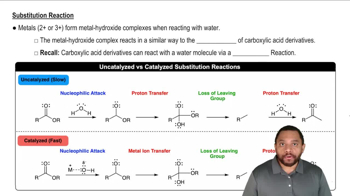
Metal Ion Catalysis: Water Activation Concept 2

General-Base Catalysis

General-base catalysis involves the transfer of protons (H+) from a substrate to a base, which is often an amino acid side chain in the enzyme's active site. This process enhances the reaction rate by stabilizing the transition state. The effectiveness of a general-base catalyst is influenced by the pKa of the catalytic group, which determines its protonation state at a given pH.
Video consigliato:
Percorso guidato
2:50
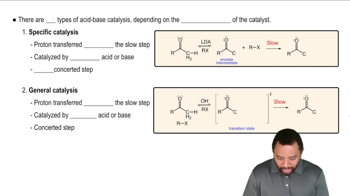
Acid-Base Catalysis Concept 3

pKa and Ionization

The pKa value of a functional group indicates the pH at which half of the molecules of that group are deprotonated. For a general-base catalyst with a pKa of 7.2, it will be predominantly deprotonated (active) at pH values above 7.2, allowing it to effectively accept protons from the substrate. Understanding the relationship between pH and pKa is essential for predicting enzyme activity and the shape of the pH-activity profile.
Video consigliato:
07:45
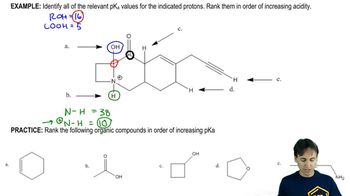
Identifying pKa values