
Ch.7 Chemical Reactions: Energy, Rate and Equilibrium
McMurry - Fundamentals of General, Organic, and Biological Chemistry 8th Edition
McMurry8th EditionFundamentals of General, Organic, and Biological ChemistryISBN: 9780134015187당신이 사용하는 게 아니라요?교과서 변경
7장, 문제 66b

The reaction Fe3+(aq) + Cl-(aq) ⇌ FeCl2+(aq) is endothermic. How will the equilibrium concentration of FeCl2+ change when
b. Cl- is precipitated by addition of AgNO3?

검증된 단계별 안내
1
Identify the key components of the reaction: The reaction is Fe³⁺(aq) + Cl⁻(aq) ⇌ FeCl²⁺(aq), and it is endothermic. The equilibrium depends on the concentrations of Fe³⁺, Cl⁻, and FeCl²⁺.
Understand the effect of adding AgNO₃: Ag⁺ ions from AgNO₃ will react with Cl⁻ ions to form a precipitate of AgCl (Ag⁺(aq) + Cl⁻(aq) → AgCl(s)). This reduces the concentration of Cl⁻ in the solution.
Apply Le Châtelier's Principle: When the concentration of Cl⁻ decreases, the equilibrium will shift to counteract this change by producing more Cl⁻. This means the reaction will shift to the left (toward the reactants).
Determine the effect on FeCl²⁺: As the equilibrium shifts to the left, the concentration of FeCl²⁺ will decrease because it is being converted back into Fe³⁺ and Cl⁻.
Summarize the result: The equilibrium concentration of FeCl²⁺ will decrease when Cl⁻ is precipitated by the addition of AgNO₃.

비슷한 문제에 대한 검증된 영상 답변:

이 영상 해법은 위 문제에 도움이 된다고 튜터들이 추천한 것입니다.
영상 길이:
1m
도움이 되었나요?

주요 개념

질문에 올바르게 답하기 위해 반드시 이해해야 하는 핵심 개념들은 다음과 같습니다.

Le Chatelier's Principle

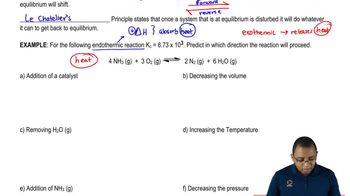
Le Chatelier's Principle states that if a dynamic equilibrium is disturbed by changing the conditions, the position of equilibrium shifts to counteract the change. In this case, adding AgNO3 causes Cl- ions to precipitate, which reduces their concentration in the solution. According to Le Chatelier's Principle, the equilibrium will shift to the right to produce more Cl- ions, thereby increasing the concentration of FeCl2+.
추천 영상:
가이드 코스
09:34
The following is an endothermic reaction where Kc = 6.73 x 10³.For each of the choices below predict in which direction the reaction will proceed

Equilibrium Constant (K)

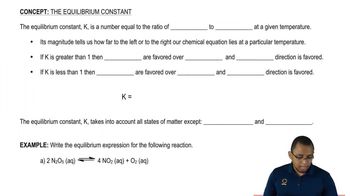
The equilibrium constant (K) is a numerical value that expresses the ratio of the concentrations of products to reactants at equilibrium for a given reaction at a specific temperature. For the reaction Fe3+ + Cl- ⇌ FeCl2+, the equilibrium constant can help predict how changes in concentration will affect the system. If Cl- is removed from the solution, the equilibrium constant remains unchanged, but the concentrations of the species will adjust to restore equilibrium.
추천 영상:
가이드 코스
02:50
The Equilibrium Constant Concept 1

Endothermic Reactions

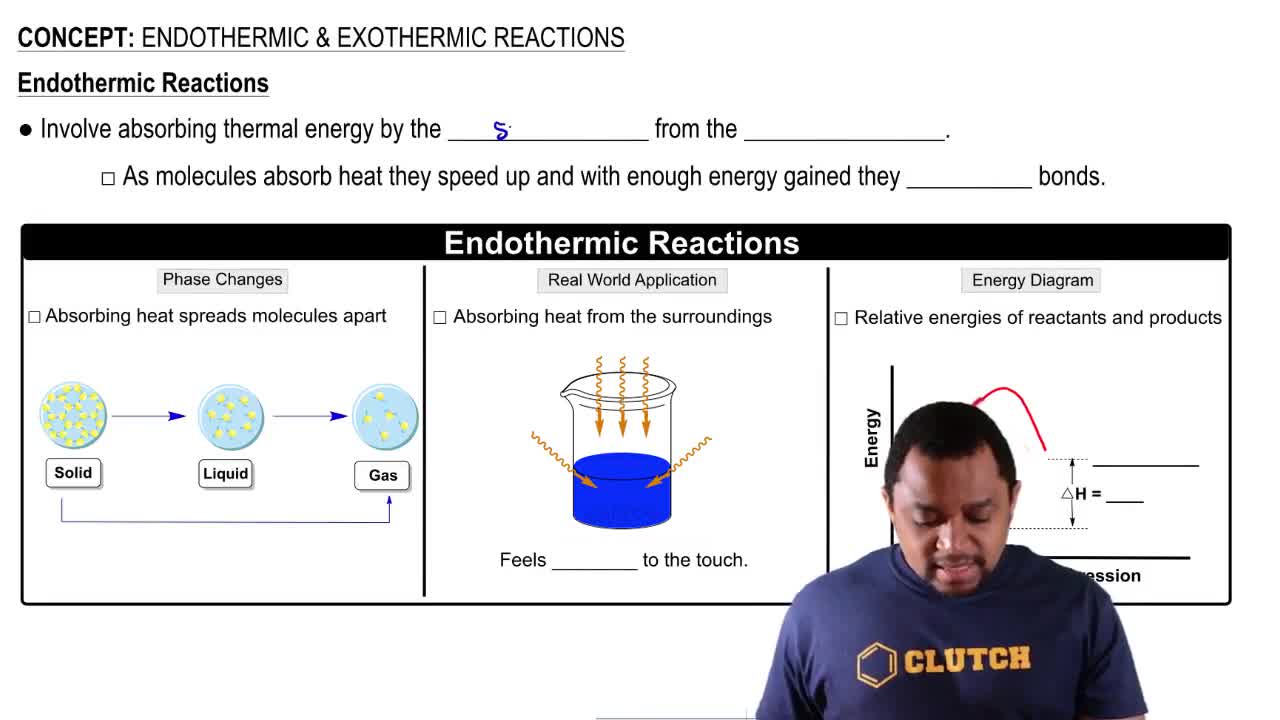
An endothermic reaction is one that absorbs heat from its surroundings, resulting in a decrease in temperature of the environment. In the context of the given reaction, the endothermic nature implies that increasing temperature will favor the formation of products. However, in this scenario, the focus is on the concentration changes due to the precipitation of Cl-, which will influence the equilibrium position without directly altering the temperature.
추천 영상:
가이드 코스
02:30
Endothermic & Exothermic Reactions