
Ch.7 Chemical Reactions: Energy, Rate and Equilibrium
McMurry - Fundamentals of General, Organic, and Biological Chemistry 8th Edition
McMurry8th EditionFundamentals of General, Organic, and Biological ChemistryISBN: 9780134015187당신이 사용하는 게 아니라요?교과서 변경
7장, 문제 65c

The reaction H2(g) + I2(g) ⇌ 2 HI(g) has ∆H = -2.2 kcal/mol (-9.2 kJ/mol). Will the equilibrium concentration of HI increase or decrease when
c. A catalyst is added?

검증된 단계별 안내
1
Understand the role of a catalyst: A catalyst speeds up the rate of a chemical reaction by lowering the activation energy, but it does not affect the position of equilibrium or the concentrations of reactants and products at equilibrium.
Recall Le Chatelier's Principle: This principle states that if a system at equilibrium is disturbed, the system will adjust to minimize the disturbance and re-establish equilibrium. However, adding a catalyst does not count as a disturbance to the equilibrium conditions.
Analyze the effect of the catalyst: Since a catalyst does not change the ∆H (enthalpy change) of the reaction or the equilibrium constant (K), it will not alter the equilibrium concentrations of H₂, I₂, or HI.
Conclude the impact on HI concentration: Adding a catalyst will not increase or decrease the equilibrium concentration of HI. It will only allow the system to reach equilibrium faster if it is not already at equilibrium.
Summarize: The equilibrium concentration of HI will remain unchanged when a catalyst is added.

비슷한 문제에 대한 검증된 영상 답변:

이 영상 해법은 위 문제에 도움이 된다고 튜터들이 추천한 것입니다.
영상 길이:
1m

주요 개념

질문에 올바르게 답하기 위해 반드시 이해해야 하는 핵심 개념들은 다음과 같습니다.

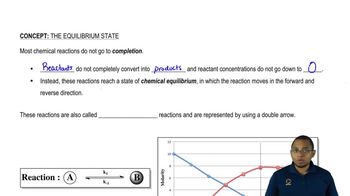
Chemical Equilibrium

Chemical equilibrium occurs when the rates of the forward and reverse reactions are equal, resulting in constant concentrations of reactants and products. In the given reaction, H2 and I2 combine to form HI, and the system can shift in response to changes in conditions, such as concentration, temperature, or pressure.
추천 영상:
가이드 코스
03:42
Chemical Equilibrium Concept 1

Catalysts

A catalyst is a substance that increases the rate of a chemical reaction without being consumed in the process. It works by lowering the activation energy required for the reaction to occur. Importantly, while catalysts speed up the attainment of equilibrium, they do not change the position of the equilibrium itself or the concentrations of reactants and products at equilibrium.
추천 영상:
가이드 코스
1:17
Coupled Reactions Example 3

Le Chatelier's Principle

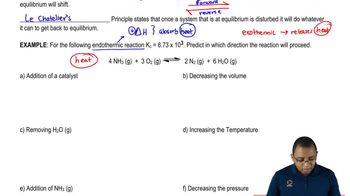
Le Chatelier's Principle states that if a dynamic equilibrium is disturbed by changing the conditions, the system will adjust to counteract the change and restore a new equilibrium. In the context of the reaction provided, adding a catalyst does not disturb the equilibrium concentrations of H2, I2, or HI, meaning the equilibrium position remains unchanged.
추천 영상:
가이드 코스
09:34
The following is an endothermic reaction where Kc = 6.73 x 10³.For each of the choices below predict in which direction the reaction will proceed