
Ch.23 Lipids
McMurry - Fundamentals of General, Organic, and Biological Chemistry 8th Edition
McMurry8th EditionFundamentals of General, Organic, and Biological ChemistryISBN: 9780134015187당신이 사용하는 게 아니라요?교과서 변경
23장, 문제 51

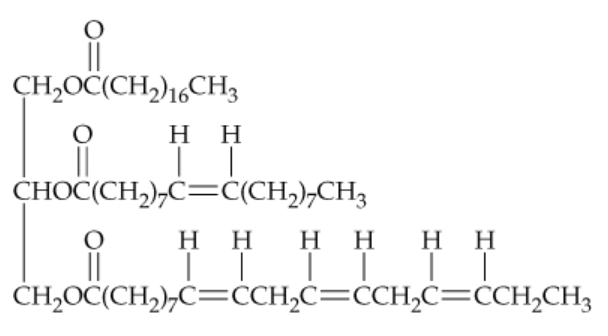
Tell how many different products you would obtain on hydrogenation of the triacylglycerol in Problem 23.49 if:
Chemical structure of triacylglycerol showing multiple double bonds, illustrating hydrogenation reactions and product variations.
a. One double bond was converted to a single bond
b. Two double bonds were converted to single bonds
c. Three double bonds were converted to single bonds
d. All four double bonds were converted to single bonds

검증된 단계별 안내
1
Step 1: Understand the structure of a triacylglycerol. A triacylglycerol is composed of a glycerol backbone with three fatty acid chains attached via ester bonds. The fatty acid chains may contain double bonds, which are sites of unsaturation.
Step 2: Recognize the process of hydrogenation. Hydrogenation involves the addition of hydrogen (H₂) to double bonds in the fatty acid chains, converting them into single bonds. Each double bond can be reduced to a single bond during this process.
Step 3: Analyze the scenario for part (a). If one double bond is converted to a single bond, consider the number of possible positions where this hydrogenation can occur. Each unique fatty acid chain and its double bond position will result in a different product.
Step 4: Extend the analysis for parts (b), (c), and (d). For two, three, or all four double bonds being converted to single bonds, calculate the number of possible combinations of double bonds that can be hydrogenated. This will depend on the specific arrangement of double bonds in the fatty acid chains.
Step 5: Summarize the results. For each part (a-d), the number of different products corresponds to the number of unique ways the double bonds can be selectively hydrogenated. This requires considering the structure of the triacylglycerol and the positions of the double bonds in the fatty acid chains.

비슷한 문제에 대한 검증된 영상 답변:

이 영상 해법은 위 문제에 도움이 된다고 튜터들이 추천한 것입니다.
영상 길이:
4m
도움이 되었나요?

주요 개념

질문에 올바르게 답하기 위해 반드시 이해해야 하는 핵심 개념들은 다음과 같습니다.

Triacylglycerol Structure

Triacylglycerols, or triglycerides, are esters formed from glycerol and three fatty acids. The fatty acids can contain one or more double bonds, which influence the physical properties and reactivity of the molecule. Understanding the structure of triacylglycerols is essential for predicting the products of hydrogenation, as the number and position of double bonds determine how many hydrogen atoms can be added.
추천 영상:
가이드 코스
1:52
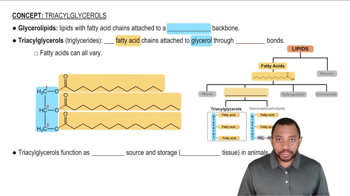
Triacylglycerols Concept 1

Hydrogenation Process

Hydrogenation is a chemical reaction that involves the addition of hydrogen (H2) to unsaturated bonds, typically double bonds in fatty acids. This process converts double bonds into single bonds, resulting in a more saturated fat. The extent of hydrogenation affects the number of products formed, as each double bond that is hydrogenated can lead to different structural isomers depending on the original configuration of the fatty acids.
추천 영상:
가이드 코스
0:49
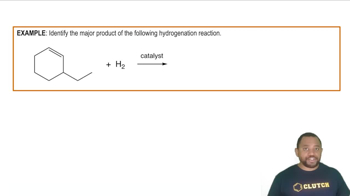
Hydrogenation Reactions Example 1

Isomer Formation

Isomer formation refers to the creation of different structural forms of a compound that have the same molecular formula but different arrangements of atoms. In the context of hydrogenation of triacylglycerols, the conversion of double bonds to single bonds can lead to various isomers, depending on the original configuration of the fatty acids. Understanding isomer formation is crucial for predicting the diversity of products resulting from the hydrogenation process.
추천 영상:
가이드 코스
2:16
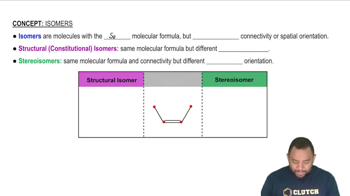
Isomers Concept 1