
Ch.23 Lipids
McMurry - Fundamentals of General, Organic, and Biological Chemistry 8th Edition
McMurry8th EditionFundamentals of General, Organic, and Biological ChemistryISBN: 9780134015187당신이 사용하는 게 아니라요?교과서 변경
23장, 문제 58

Why are glycerophospholipids more soluble in water than triacylglycerols?

검증된 단계별 안내
1
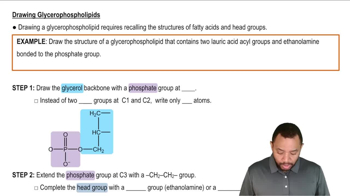
Understand the structure of glycerophospholipids: These molecules consist of a glycerol backbone, two fatty acid chains, and a phosphate group attached to a polar head group. The phosphate group and polar head group make the molecule amphipathic, meaning it has both hydrophilic (water-attracting) and hydrophobic (water-repelling) regions.
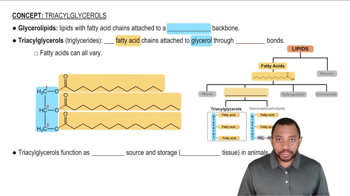
Understand the structure of triacylglycerols: These molecules consist of a glycerol backbone and three fatty acid chains. They are nonpolar and hydrophobic, meaning they do not interact well with water.
Compare the solubility in water: Glycerophospholipids have a polar head group due to the phosphate group, which can form hydrogen bonds and interact with water molecules. This makes them more soluble in water compared to triacylglycerols, which lack a polar region and are entirely hydrophobic.
Relate solubility to amphipathic nature: The amphipathic nature of glycerophospholipids allows them to align at water interfaces, with their hydrophilic heads interacting with water and their hydrophobic tails avoiding it. This property enhances their solubility in aqueous environments.
Conclude the reasoning: The presence of the polar phosphate group and the amphipathic nature of glycerophospholipids make them more soluble in water than triacylglycerols, which are purely hydrophobic and lack any polar functional groups.

비슷한 문제에 대한 검증된 영상 답변:

이 영상 해법은 위 문제에 도움이 된다고 튜터들이 추천한 것입니다.
영상 길이:
2m
도움이 되었나요?

주요 개념

질문에 올바르게 답하기 위해 반드시 이해해야 하는 핵심 개념들은 다음과 같습니다.

Glycerophospholipids Structure

Glycerophospholipids are composed of a glycerol backbone, two fatty acid tails, and a phosphate group. The presence of the phosphate group, which is polar and hydrophilic, allows glycerophospholipids to interact favorably with water molecules, enhancing their solubility in aqueous environments.
추천 영상:
가이드 코스
2:32
Glycerophospholipids Example 3

Triacylglycerols Structure

Triacylglycerols, or triglycerides, consist of a glycerol molecule bonded to three fatty acid chains. These fatty acids are typically long and hydrophobic, making triacylglycerols largely nonpolar and less soluble in water. Their structure is primarily designed for energy storage rather than solubility.
추천 영상:
가이드 코스
1:52
Triacylglycerols Concept 1

Hydrophilicity vs. Hydrophobicity

Hydrophilicity refers to the affinity of a molecule for water, while hydrophobicity indicates a lack of such affinity. Glycerophospholipids, with their polar head groups, are hydrophilic, allowing them to dissolve in water, whereas triacylglycerols are hydrophobic due to their long nonpolar fatty acid chains, leading to poor solubility in water.
추천 영상:
가이드 코스
3:33
Enantiomers vs Diastereomers Concept 1