Ch.26 Nucleic Acids and Protein Synthesis
McMurry - Fundamentals of General, Organic, and Biological Chemistry 8th Edition
McMurry8th EditionFundamentals of General, Organic, and Biological ChemistryISBN: 9780134015187당신이 사용하는 게 아니라요?교과서 변경
26장, 문제 12

What are Okazaki fragments? What role do they serve in DNA metabolism?

검증된 단계별 안내
1
Okazaki fragments are short sequences of DNA nucleotides (typically 100-200 nucleotides in eukaryotes and 1000-2000 in prokaryotes) that are synthesized discontinuously during DNA replication on the lagging strand.
DNA replication is semi-conservative and occurs in the 5' to 3' direction. Since the two strands of DNA are antiparallel, the leading strand is synthesized continuously, while the lagging strand is synthesized in short, discontinuous segments called Okazaki fragments.
The role of Okazaki fragments is to enable the replication of the lagging strand, which cannot be synthesized continuously due to the antiparallel nature of DNA and the unidirectional activity of DNA polymerase.
Once the Okazaki fragments are synthesized, an enzyme called DNA ligase joins these fragments together by forming phosphodiester bonds, creating a continuous DNA strand.
In summary, Okazaki fragments are essential for the accurate and complete replication of the lagging strand, ensuring that the entire DNA molecule is duplicated during cell division.

비슷한 문제에 대한 검증된 영상 답변:

이 영상 해법은 위 문제에 도움이 된다고 튜터들이 추천한 것입니다.
영상 길이:
3m

주요 개념

질문에 올바르게 답하기 위해 반드시 이해해야 하는 핵심 개념들은 다음과 같습니다.

Okazaki Fragments

Okazaki fragments are short sequences of DNA, typically ranging from 100 to 200 nucleotides in eukaryotes, that are synthesized on the lagging strand during DNA replication. They are formed because DNA polymerase can only synthesize DNA in the 5' to 3' direction, necessitating the creation of these fragments as the replication fork opens up.
추천 영상:
가이드 코스
1:31
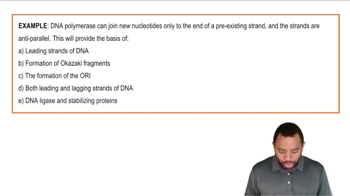
Steps of DNA Replication Example 1

DNA Replication

DNA replication is the biological process by which a cell duplicates its DNA, ensuring that each daughter cell receives an exact copy of the genetic material. This process involves unwinding the double helix, synthesizing new strands, and requires various enzymes, including DNA polymerases, helicases, and ligases, to facilitate the accurate and efficient copying of DNA.
추천 영상:
가이드 코스
1:40
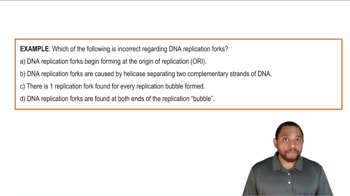
Intro to DNA Replication Example 2

Lagging Strand

The lagging strand is one of the two strands of DNA being replicated during DNA synthesis. It is synthesized discontinuously in short segments (Okazaki fragments) because it runs in the opposite direction to the replication fork movement. This results in a more complex synthesis process compared to the leading strand, which is synthesized continuously.
추천 영상:
가이드 코스
1:31
Steps of DNA Replication Example 1