Ch. 12 - Radicals
Bruice - Organic Chemistry 8th Edition
Bruice8th EditionOrganic ChemistryISBN: 9780135213711당신이 사용하는 게 아니라요?교과서 변경
12장, 문제 41b

Given that ∆H° for the reaction is -42 kcal/mol and the bond dissociation enthalpies for the C−H, C−Cl, and O−H bonds are 101, 85, and 105 kcal/mol respectively, calculate the bond dissociation enthalpy of the O−Cl bond.
Chemical reaction showing the conversion of a chlorinated compound to products, with bond enthalpy values indicated.

검증된 단계별 안내
1
Step 1: Analyze the reaction provided in the image. The reactants are tert-butyl hypochlorite (C4H9OCl) and isobutane (C4H10), and the products are tert-butyl alcohol (C4H9OH) and tert-butyl chloride (C4H9Cl). This reaction involves bond dissociation and formation.
Step 2: Write the bond dissociation and formation processes. Bonds broken: C−H (from isobutane), O−Cl (from tert-butyl hypochlorite). Bonds formed: O−H (in tert-butyl alcohol), C−Cl (in tert-butyl chloride).
Step 3: Use the enthalpy change formula for the reaction: ∆H° = Σ(Bonds broken) − Σ(Bonds formed). Substitute the given values: ∆H° = -42 kcal/mol, bond dissociation enthalpies for C−H = 101 kcal/mol, C−Cl = 85 kcal/mol, O−H = 105 kcal/mol.
Step 4: Rearrange the formula to solve for the bond dissociation enthalpy of O−Cl. Let the bond dissociation enthalpy of O−Cl be x. The equation becomes: -42 = (101 + x) − (85 + 105).
Step 5: Simplify the equation to isolate x. Perform algebraic manipulation to calculate the bond dissociation enthalpy of O−Cl.

비슷한 문제에 대한 검증된 영상 답변:

이 영상 해법은 위 문제에 도움이 된다고 튜터들이 추천한 것입니다.
영상 길이:
7m

주요 개념

질문에 올바르게 답하기 위해 반드시 이해해야 하는 핵심 개념들은 다음과 같습니다.

Bond Dissociation Enthalpy (BDE)

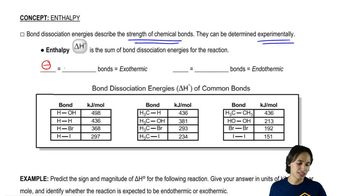
Bond dissociation enthalpy is the energy required to break a specific bond in a molecule, resulting in the formation of free radicals. It is typically expressed in kcal/mol and reflects the strength of the bond; higher values indicate stronger bonds. Understanding BDE is crucial for predicting reaction pathways and the stability of intermediates in organic reactions.
추천 영상:
04:09
How to calculate enthalpy using bond dissociation energies.

Enthalpy Change (∆H°)

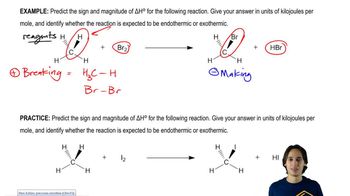
Enthalpy change (∆H°) is the heat content change associated with a chemical reaction at constant pressure. A negative ∆H° indicates that the reaction is exothermic, releasing energy, while a positive ∆H° signifies an endothermic reaction, absorbing energy. This concept is essential for calculating the overall energy changes in reactions, including bond formation and breaking.
추천 영상:
04:38
Calculating Enthalpies

Reaction Mechanism

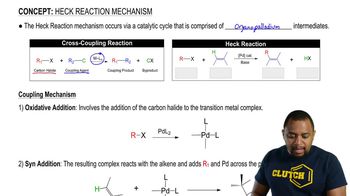
A reaction mechanism describes the step-by-step sequence of elementary reactions by which overall chemical change occurs. It provides insight into how reactants are converted into products, including the formation and breaking of bonds. Understanding the mechanism is vital for predicting the products of a reaction and calculating the associated energy changes, such as bond dissociation enthalpies.
추천 영상:
02:16
Heck Reaction Mechanism