Ch. 12 - Radicals
Bruice - Organic Chemistry 8th Edition
Bruice8th EditionOrganic ChemistryISBN: 9780135213711당신이 사용하는 게 아니라요?교과서 변경
12장, 문제 41a

Propose a mechanism for the following reaction:

검증된 단계별 안내
1
Step 1: Analyze the reactants and products. The reactants are ethane (CH₃CH₃) and tert-butyl hypochlorite (CH₃C(OCl)(CH₃)₂). The products are ethyl chloride (CH₃CH₂Cl) and tert-butanol (CH₃C(OH)(CH₃)₂). This suggests a radical substitution mechanism.
Step 2: Initiation step. The reaction is initiated by heat (Δ), which causes the homolytic cleavage of the O-Cl bond in tert-butyl hypochlorite, generating a tert-butoxy radical (CH₃C(O•)(CH₃)₂) and a chlorine radical (Cl•).
Step 3: Propagation step 1. The chlorine radical (Cl•) abstracts a hydrogen atom from ethane (CH₃CH₃), forming ethyl radical (CH₃CH₂•) and HCl.
Step 4: Propagation step 2. The ethyl radical (CH₃CH₂•) reacts with another molecule of tert-butyl hypochlorite (CH₃C(OCl)(CH₃)₂), forming ethyl chloride (CH₃CH₂Cl) and regenerating the tert-butoxy radical (CH₃C(O•)(CH₃)₂).
Step 5: Termination step. Two tert-butoxy radicals (CH₃C(O•)(CH₃)₂) combine to form tert-butanol (CH₃C(OH)(CH₃)₂), completing the reaction.

비슷한 문제에 대한 검증된 영상 답변:

이 영상 해법은 위 문제에 도움이 된다고 튜터들이 추천한 것입니다.
영상 길이:
8m

주요 개념

질문에 올바르게 답하기 위해 반드시 이해해야 하는 핵심 개념들은 다음과 같습니다.

Reaction Mechanism

A reaction mechanism is a step-by-step description of how a chemical reaction occurs at the molecular level. It outlines the sequence of elementary steps, including bond breaking and formation, and the intermediates formed during the reaction. Understanding the mechanism helps predict the products and the conditions under which the reaction occurs.
추천 영상:
02:16
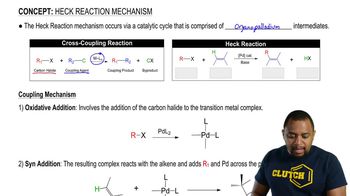
Heck Reaction Mechanism

Nucleophiles and Electrophiles

Nucleophiles are species that donate an electron pair to form a chemical bond, while electrophiles are electron-deficient species that accept an electron pair. In organic reactions, identifying the nucleophile and electrophile is crucial for proposing a mechanism, as it determines the direction of electron flow and the formation of products.
추천 영상:
03:
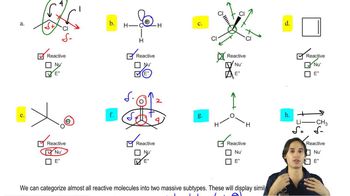
Nucleophile or Electrophile

Transition States and Intermediates

Transition states are high-energy states that occur during the transformation from reactants to products, representing the point of maximum energy along the reaction pathway. Intermediates are species that are formed and consumed during the reaction but are not present in the final products. Understanding these concepts is essential for accurately depicting the mechanism and energy changes throughout the reaction.
추천 영상:
06:55
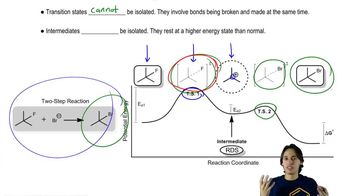
Intermediates vs. Transition States