Ch. 12 - Radicals
Bruice - Organic Chemistry 8th Edition
Bruice8th EditionOrganic ChemistryISBN: 9780135213711당신이 사용하는 게 아니라요?교과서 변경
12장, 문제 43c

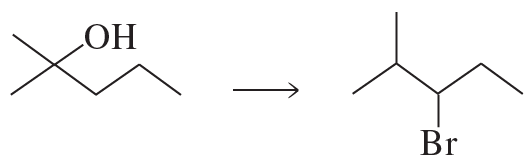
Using the given starting material and any necessary organic or inorganic reagents, indicate how the desired compounds could be synthesized:
c. Synthesis pathway showing conversion of an alcohol to a brominated compound with structural formulas.

검증된 단계별 안내
1
Step 1: Analyze the starting material and the desired product. The starting material is a secondary alcohol, and the desired product is a secondary alkyl bromide. This suggests that the reaction involves the conversion of an alcohol to an alkyl halide.
Step 2: Select an appropriate reagent for converting alcohols to alkyl halides. A common reagent for this transformation is phosphorus tribromide (PBr₃), which reacts with alcohols to produce alkyl bromides.
Step 3: Write the reaction mechanism. The alcohol reacts with PBr₃, where the hydroxyl group (-OH) is replaced by a bromine atom (Br). This occurs via nucleophilic substitution (SN2 mechanism) for secondary alcohols.
Step 4: Ensure reaction conditions are suitable. The reaction with PBr₃ typically occurs under mild conditions and does not require heating. It is important to use anhydrous conditions to prevent side reactions.
Step 5: Verify the stereochemistry of the product. Since the reaction proceeds via an SN2 mechanism, inversion of configuration at the carbon center may occur. Ensure the product matches the desired stereochemistry.

비슷한 문제에 대한 검증된 영상 답변:

이 영상 해법은 위 문제에 도움이 된다고 튜터들이 추천한 것입니다.
영상 길이:
5m
도움이 되었나요?

주요 개념

질문에 올바르게 답하기 위해 반드시 이해해야 하는 핵심 개념들은 다음과 같습니다.

Radical Reactions

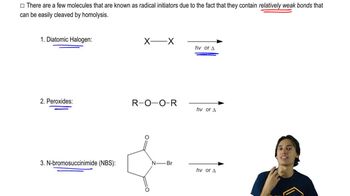
Radical reactions involve the formation and reaction of free radicals, which are highly reactive species with unpaired electrons. In organic synthesis, these reactions can be initiated by heat or light, leading to the substitution of atoms in a molecule. For example, in the synthesis of brominated compounds, a radical initiator can abstract a hydrogen atom from an alcohol, generating a radical that can then react with bromine.
추천 영상:
03:49
What are Radical Initiators?

Bromination of Alcohols

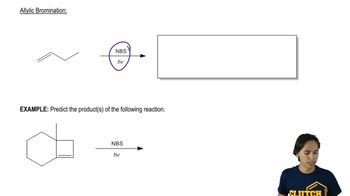
Bromination of alcohols typically involves converting the alcohol into a more reactive species, such as a bromide. This can be achieved through radical mechanisms where the hydroxyl group is replaced by a bromine atom. The process often requires the presence of a brominating agent, such as N-bromosuccinimide (NBS), which facilitates the substitution reaction under radical conditions.
추천 영상:
00:54
Mechanism of Allylic Bromination.

Mechanism of Substitution Reactions

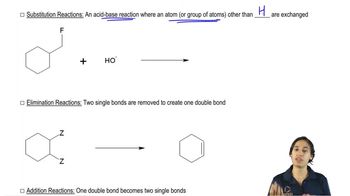
Substitution reactions can occur via different mechanisms, including radical, nucleophilic, and electrophilic pathways. In the context of radical bromination, the mechanism typically involves initiation, propagation, and termination steps. Understanding these steps is crucial for predicting the outcome of the reaction, including regioselectivity and stereochemistry, which are important for synthesizing the desired brominated compound.
추천 영상:
01:34
Recognizing Substitution Reactions.