Ch. 10 - Alkynes: Electrophilic Addition and Redox Reactions
Mullins - Organic Chemistry: A Learner Centered Approach 1st Edition
Mullins1st EditionOrganic Chemistry: A Learner Centered ApproachISBN: 9780137566471당신이 사용하는 게 아니라요?교과서 변경
9장, 문제 20b

Suggest reagents you might use to generate the product from the given reactant.
(b)

검증된 단계별 안내
1
Analyze the reactant and product structures: The reactant is a terminal alkyne (with a hydrogen attached to the triple bond), and the product is an internal alkyne with additional alkyl groups attached. This suggests an alkylation reaction of the terminal alkyne.
Identify the type of reaction: Terminal alkynes can undergo alkylation using a strong base to deprotonate the terminal hydrogen, followed by reaction with an alkyl halide to introduce the desired alkyl group.
Choose the base: Use a strong base such as sodium amide (NaNH₂) or potassium tert-butoxide (KOtBu) to deprotonate the terminal alkyne and generate the acetylide ion.
Select the alkyl halide: To introduce the bulky tert-butyl group, use tert-butyl bromide (C₄H₉Br) or tert-butyl chloride (C₄H₉Cl) as the alkylating agent.
Perform the reaction: First, treat the terminal alkyne with the strong base to form the acetylide ion. Then, add the alkyl halide to allow the nucleophilic substitution reaction, resulting in the formation of the internal alkyne product.

비슷한 문제에 대한 검증된 영상 답변:

이 영상 해법은 위 문제에 도움이 된다고 튜터들이 추천한 것입니다.

주요 개념

질문에 올바르게 답하기 위해 반드시 이해해야 하는 핵심 개념들은 다음과 같습니다.

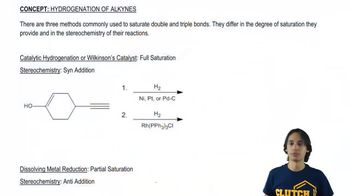
Hydrogenation

Hydrogenation is a chemical reaction that involves the addition of hydrogen (H2) to unsaturated hydrocarbons, such as alkenes and alkynes, converting them into saturated hydrocarbons. This process typically requires a catalyst, such as palladium, platinum, or nickel, to facilitate the reaction. In the context of the provided image, hydrogenation would convert the alkyne into an alkene or alkane, depending on the extent of hydrogen addition.
추천 영상:
00:48
The definition of hydrogenation.

Reagents for Alkene Formation

To generate alkenes from alkynes, specific reagents can be employed, such as Lindlar's catalyst for partial hydrogenation, which selectively converts alkynes to cis-alkenes. Alternatively, reagents like sodium in liquid ammonia can be used for the reduction of alkynes to trans-alkenes. Understanding the choice of reagents is crucial for controlling the stereochemistry and the degree of saturation in the product.
추천 영상:
가이드 코스
2:09
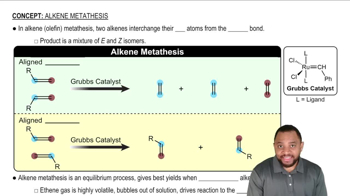
Alkene Metathesis Concept 1

Markovnikov's Rule

Markovnikov's Rule is a principle that predicts the regioselectivity of electrophilic addition reactions to alkenes. It states that when HX (where X is a halogen or other substituent) is added to an asymmetric alkene, the hydrogen atom will attach to the carbon with the greater number of hydrogen atoms, while the X will attach to the carbon with fewer hydrogen atoms. This concept is essential for predicting the outcome of reactions involving alkenes and understanding the formation of products in organic synthesis.
추천 영상:
03:54
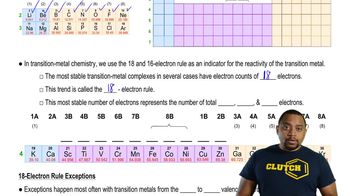
The 18 and 16 Electron Rule