Ch. 12 - Substitution and Elimination: Reactions of Haloalkanes
Mullins - Organic Chemistry: A Learner Centered Approach 1st Edition
Mullins1st EditionOrganic Chemistry: A Learner Centered ApproachISBN: 9780137566471당신이 사용하는 게 아니라요?교과서 변경
11장, 문제 22a

Which nucleophile would be more reactive in the solvent given?
(a) Comparison of the reactivity of the nucleophiles S⁻ and O⁻ in water.

검증된 단계별 안내
1
Identify the nucleophiles in the problem. A nucleophile is a species that donates a pair of electrons to form a new covalent bond. Look at the structures provided and determine their electron-rich centers (e.g., lone pairs, negative charges, or π-electrons).
Consider the solvent type. Solvents can be protic (e.g., water, alcohols) or aprotic (e.g., acetone, DMSO). Protic solvents can hydrogen bond with nucleophiles, stabilizing them and reducing their reactivity, while aprotic solvents do not hydrogen bond and allow nucleophiles to remain more reactive.
Evaluate the nucleophiles' basicity and charge. Generally, negatively charged nucleophiles are more reactive than neutral ones, and stronger bases tend to be better nucleophiles in aprotic solvents. However, in protic solvents, smaller nucleophiles may be less reactive due to solvation effects.
Analyze steric hindrance. Bulky nucleophiles are less reactive because their size makes it harder for them to approach the electrophile. Compare the steric profiles of the nucleophiles provided in the problem.
Combine all factors (solvent type, charge, basicity, and steric hindrance) to determine which nucleophile would be more reactive in the given solvent. Use this analysis to make your conclusion.

비슷한 문제에 대한 검증된 영상 답변:

이 영상 해법은 위 문제에 도움이 된다고 튜터들이 추천한 것입니다.
영상 길이:
2m

주요 개념

질문에 올바르게 답하기 위해 반드시 이해해야 하는 핵심 개념들은 다음과 같습니다.

Nucleophilicity

Nucleophilicity refers to the ability of a species to donate an electron pair to an electrophile, forming a chemical bond. Factors influencing nucleophilicity include charge, electronegativity, and solvent effects. Generally, negatively charged species are more nucleophilic than their neutral counterparts, and nucleophilicity can vary significantly depending on the solvent used.
추천 영상:
08:27
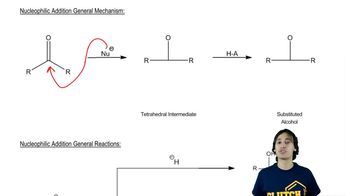
Nucleophilic Addition

Solvent Effects

The solvent can significantly influence the reactivity of nucleophiles. Polar protic solvents can stabilize nucleophiles through hydrogen bonding, often reducing their reactivity, while polar aprotic solvents can enhance nucleophilicity by not stabilizing the nucleophile as much. Understanding the solvent's nature is crucial for predicting the outcome of nucleophilic reactions.
추천 영상:
01:16
Identification of polarity in solvents

Electrophilicity

Electrophilicity is the tendency of a species to accept an electron pair from a nucleophile. Electrophiles are typically electron-deficient and can be positively charged or neutral with a partial positive charge. The strength of an electrophile can affect the reactivity of nucleophiles, as stronger electrophiles will react more readily with nucleophiles.
추천 영상:
03:
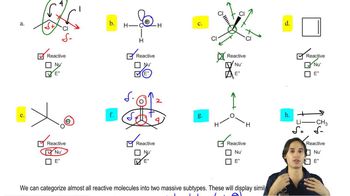
Nucleophile or Electrophile