Ch. 13 - Alcohols, Ethers and Related Compounds: Substitution and Elimination
Mullins - Organic Chemistry: A Learner Centered Approach 1st Edition
Mullins1st EditionOrganic Chemistry: A Learner Centered ApproachISBN: 9780137566471당신이 사용하는 게 아니라요?교과서 변경
12장, 문제 65

Ethers can be converted into radicals, some more easily than others. Which of the following radicals is more stable, and thus, more likely to form?
Three ether radicals: methoxy, ethoxy, and isopropoxy, depicted with dots indicating unpaired electrons.

검증된 단계별 안내
1
Understand the concept of radical stability: In organic chemistry, radicals are atoms or molecules that have unpaired electrons. The stability of a radical is influenced by several factors, including the presence of electron-donating groups, resonance stabilization, and hyperconjugation.
Identify the types of radicals: Ethers can form different types of radicals depending on the structure of the ether. Common radicals include primary, secondary, and tertiary radicals, as well as allylic and benzylic radicals.
Evaluate the stability of each radical: Generally, tertiary radicals are more stable than secondary radicals, which are more stable than primary radicals. This is due to hyperconjugation and the inductive effect of alkyl groups. Additionally, radicals that are resonance-stabilized, such as allylic and benzylic radicals, are particularly stable.
Consider resonance effects: If the radical can be stabilized by resonance, it will be more stable. For example, a benzylic radical is stabilized by the aromatic ring through resonance, making it more stable than a simple alkyl radical.
Compare the radicals: Based on the factors discussed, compare the radicals formed from the ether. Determine which radical has the greatest stability due to hyperconjugation, resonance, or other stabilizing effects.

비슷한 문제에 대한 검증된 영상 답변:

이 영상 해법은 위 문제에 도움이 된다고 튜터들이 추천한 것입니다.
영상 길이:
1m
도움이 되었나요?

주요 개념

질문에 올바르게 답하기 위해 반드시 이해해야 하는 핵심 개념들은 다음과 같습니다.

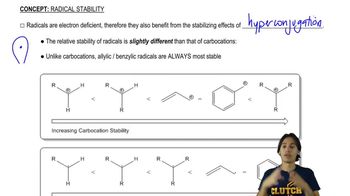
Radical Stability

Radical stability is influenced by factors such as hyperconjugation, resonance, and the inductive effect. More stable radicals have lower energy and are more likely to form. Stability increases with the number of alkyl groups attached to the radical center, as they can donate electron density through hyperconjugation.
추천 영상:
03:43
The radical stability trend.

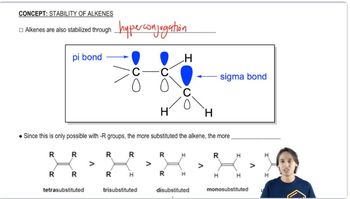
Hyperconjugation

Hyperconjugation is the delocalization of electrons in sigma bonds (typically C-H or C-C) adjacent to a radical center, which helps stabilize the radical. This effect is more pronounced in radicals with more alkyl substituents, as they provide more sigma bonds for electron delocalization, enhancing radical stability.
추천 영상:
04:28
Understanding trends of alkene stability.

Resonance Stabilization

Resonance stabilization occurs when a radical can delocalize its unpaired electron over multiple atoms, typically through pi bonds. This delocalization lowers the energy of the radical, making it more stable. Radicals that can participate in resonance are generally more stable than those that cannot.
추천 영상:
03:43
The radical stability trend.