Ch. 13 - Alcohols, Ethers and Related Compounds: Substitution and Elimination
Mullins - Organic Chemistry: A Learner Centered Approach 1st Edition
Mullins1st EditionOrganic Chemistry: A Learner Centered ApproachISBN: 9780137566471당신이 사용하는 게 아니라요?교과서 변경
12장, 문제 41a

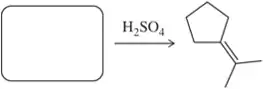
Identify the alcohol(s) that would produce the following alkenes under the given conditions.
(a) Chemical reaction diagram showing dehydration with H₂SO₄, leading to an alkene product from an unspecified alcohol.

검증된 단계별 안내
1
Step 1: Understand the reaction mechanism. The conversion of alcohols to alkenes typically occurs through an elimination reaction, such as E1 or E2, depending on the conditions. In acidic conditions, the reaction often proceeds via the E1 mechanism, involving protonation of the alcohol and formation of a carbocation intermediate.
Step 2: Analyze the structure of the given alkene. Identify the position of the double bond and the carbon atoms involved. This will help determine the possible alcohol precursors.
Step 3: Consider the regioselectivity and stereoselectivity of the elimination reaction. For example, Zaitsev's rule states that the most substituted alkene is usually favored in elimination reactions. This can help predict which alcohols are likely to produce the given alkene.
Step 4: Identify the alcohol(s) that could lead to the given alkene. For each alcohol, consider the position of the hydroxyl group (-OH) and how elimination would occur to form the double bond. Ensure that the elimination follows the correct mechanism (E1 or E2) under the given conditions.
Step 5: Verify the feasibility of the reaction. Check for factors such as carbocation stability (in E1 reactions) or the presence of a strong base (in E2 reactions) to confirm that the identified alcohol(s) can indeed produce the given alkene.

비슷한 문제에 대한 검증된 영상 답변:

이 영상 해법은 위 문제에 도움이 된다고 튜터들이 추천한 것입니다.
영상 길이:
3m

주요 개념

질문에 올바르게 답하기 위해 반드시 이해해야 하는 핵심 개념들은 다음과 같습니다.

Alcohol Dehydration

Alcohol dehydration is a chemical reaction where an alcohol loses a water molecule to form an alkene. This process typically occurs under acidic conditions, where the hydroxyl group of the alcohol is protonated, making it a better leaving group. The resulting carbocation can then undergo elimination of a proton, leading to the formation of a double bond in the alkene.
추천 영상:
01:23
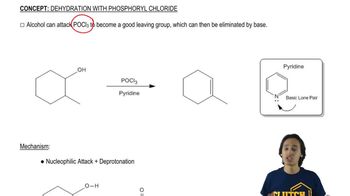
General Reaction of Dehydration with POCl3

Zaitsev's Rule

Zaitsev's Rule states that in elimination reactions, the more substituted alkene is generally the major product. This is because more substituted alkenes are more stable due to hyperconjugation and the inductive effect. Understanding this rule helps predict which alkene will be favored when multiple elimination products are possible from a given alcohol.
추천 영상:
01:18
Defining Zaitsev’s Rule

Regioselectivity

Regioselectivity refers to the preference of a chemical reaction to yield one structural isomer over others when multiple products are possible. In the context of alcohol dehydration, regioselectivity is influenced by the stability of the carbocation intermediate and the position of the double bond in the resulting alkene. Recognizing regioselectivity is crucial for determining the correct alcohol that will produce the desired alkene.
추천 영상:
05:09
Heck Reaction