Ch. 13 - Alcohols, Ethers and Related Compounds: Substitution and Elimination
Mullins - Organic Chemistry: A Learner Centered Approach 1st Edition
Mullins1st EditionOrganic Chemistry: A Learner Centered ApproachISBN: 9780137566471당신이 사용하는 게 아니라요?교과서 변경
12장, 문제 90a

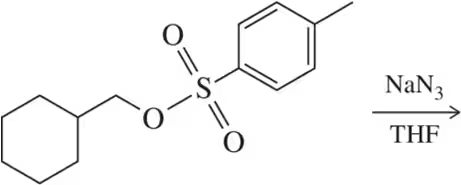
Identify whether each of the following reactions proceed by an SN1 ,SN2 , E1, or E2 mechanism.
(a) Chemical structure showing a sulfonate with a phenyl group, indicating a reaction with sodium azide in THF.

검증된 단계별 안내
1
Step 1: Analyze the substrate structure. Determine whether the carbon attached to the leaving group is primary, secondary, or tertiary. This will help narrow down the possible mechanisms, as S_N1 and E1 typically favor tertiary carbons, while S_N2 and E2 can occur with primary or secondary carbons.
Step 2: Evaluate the strength of the nucleophile or base. Strong nucleophiles favor S_N2 mechanisms, while strong bases favor E2 mechanisms. Weak nucleophiles and bases are more likely to lead to S_N1 or E1 mechanisms.
Step 3: Consider the solvent. Polar protic solvents (e.g., water, alcohols) stabilize carbocations and favor S_N1 and E1 mechanisms. Polar aprotic solvents (e.g., DMSO, acetone) favor S_N2 mechanisms by stabilizing the nucleophile.
Step 4: Assess the leaving group. A good leaving group (e.g., halides like Cl⁻, Br⁻, I⁻) is essential for all four mechanisms, but its quality can influence the reaction pathway. For example, S_N1 and E1 mechanisms are more dependent on the leaving group’s ability to stabilize the carbocation intermediate.
Step 5: Determine the reaction conditions. High temperatures often favor elimination (E1 or E2) over substitution (S_N1 or S_N2). Additionally, the presence of steric hindrance around the substrate can push the reaction toward elimination rather than substitution.

비슷한 문제에 대한 검증된 영상 답변:

이 영상 해법은 위 문제에 도움이 된다고 튜터들이 추천한 것입니다.
영상 길이:
4m

주요 개념

질문에 올바르게 답하기 위해 반드시 이해해야 하는 핵심 개념들은 다음과 같습니다.

S_N1 Mechanism

The S_N1 mechanism is a two-step nucleophilic substitution process where the rate-determining step involves the formation of a carbocation intermediate. This mechanism typically occurs in tertiary substrates due to their stability, and the reaction rate depends only on the concentration of the substrate. The nucleophile attacks the carbocation in the second step, leading to the final product.
추천 영상:
04:32
General Mechanism

S_N2 Mechanism

The S_N2 mechanism is a one-step nucleophilic substitution reaction characterized by a simultaneous bond formation and bond breaking. It involves a backside attack by the nucleophile on the substrate, leading to an inversion of configuration. This mechanism is favored in primary and some secondary substrates, and the reaction rate depends on both the substrate and nucleophile concentrations.
추천 영상:
04:32
General Mechanism

E1 and E2 Mechanisms

E1 and E2 are elimination mechanisms. E1 is a two-step process where a carbocation is formed first, followed by the loss of a proton to form a double bond, typically favored in tertiary substrates. E2 is a one-step process where a base abstracts a proton while the leaving group departs, resulting in the formation of a double bond, and is favored in primary and secondary substrates. The choice between E1 and E2 often depends on the strength of the base and the substrate structure.
추천 영상:
09:36
Drawing the E2 Mechanism.