Chapter 8 discussed the synthesis of cholesterol, which proceeds by a cationic cyclization cascade. Without looking back, suggest a mechanism by which the following reaction occurs. [The carbons have been numbered for you.]
Ch. 13 - Alcohols, Ethers and Related Compounds: Substitution and Elimination

Mullins1st EditionOrganic Chemistry: A Learner Centered ApproachISBN: 9780137566471당신이 사용하는 게 아니라요?교과서 변경
모든 교과서
Mullins 1st Edition
Ch. 13 - Alcohols, Ethers and Related Compounds: Substitution and Elimination
문제 118
Mullins 1st Edition
Ch. 13 - Alcohols, Ethers and Related Compounds: Substitution and Elimination
문제 11812장, 문제 118
Assessment 8.74 revealed that oxymercuration could be used to make cyclic esters. Suggest a likely mechanism for this transformation.

검증된 단계별 안내1
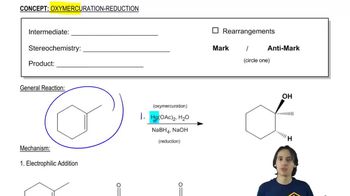
Step 1: Begin by understanding the oxymercuration reaction. Oxymercuration involves the addition of mercuric acetate (Hg(OAc)₂) to an alkene, forming a mercurinium ion intermediate.
Step 2: Analyze the structure of the starting material. The molecule contains an alkene and a hydroxyl group. The alkene is the site of the oxymercuration reaction.
Step 3: Consider the formation of the mercurinium ion. The alkene undergoes electrophilic addition with Hg(OAc)₂, forming a cyclic mercurinium ion. This intermediate is crucial for the subsequent steps.
Step 4: Examine the role of the hydroxyl group. The hydroxyl group can act as a nucleophile, attacking the mercurinium ion. This intramolecular attack leads to the formation of a cyclic ester.
Step 5: Complete the reaction with NaBH₄. Sodium borohydride (NaBH₄) is used to reduce the mercury-containing intermediate, replacing the mercury with a hydrogen atom, finalizing the formation of the cyclic ester.

비슷한 문제에 대한 검증된 영상 답변:
이 영상 해법은 위 문제에 도움이 된다고 튜터들이 추천한 것입니다.
영상 길이:
7m도움이 되었나요?
주요 개념
질문에 올바르게 답하기 위해 반드시 이해해야 하는 핵심 개념들은 다음과 같습니다.
Oxymercuration-Demercuration
Oxymercuration is a reaction that involves the addition of mercuric acetate to an alkene, forming a mercurial intermediate. This process typically leads to the formation of alcohols through nucleophilic attack by water. The subsequent demercuration step replaces the mercury with a hydrogen atom, resulting in an alcohol product. Understanding this mechanism is crucial for predicting how cyclic esters can be formed from alkenes.
추천 영상:
General properties of oxymercuration-reduction.
Cyclic Esters (Lactones)
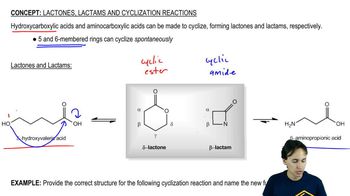
Cyclic esters, also known as lactones, are formed when a hydroxy acid undergoes intramolecular esterification. This process involves the reaction of a hydroxyl group with a carboxylic acid group within the same molecule, leading to the formation of a ring structure. Recognizing the conditions under which cyclic esters can form is essential for proposing a mechanism involving oxymercuration.
추천 영상:
Lactones and Lactams
Mechanistic Pathways in Organic Reactions
Understanding mechanistic pathways is vital in organic chemistry as it describes the step-by-step sequence of events that occur during a chemical reaction. This includes identifying intermediates, transition states, and the role of catalysts. In the context of oxymercuration leading to cyclic esters, a clear grasp of these pathways will help in suggesting a plausible mechanism for the transformation.
추천 영상:
가이드 코스
Energy Production In Biochemical Pathways Example 1
관련 실천
교과서 질문
972
views
교과서 질문
The acid-catalyzed dehydration we learned in this chapter is reversible, as shown below.
(b) Without looking back, how do you know this mechanism is correct?
858
views
교과서 질문
The acid-catalyzed dehydration we learned in this chapter is reversible, as shown below.
(c) Which side of the reaction would be favored by running the reaction at low temperatures?
1212
views
교과서 질문
The acid-catalyzed dehydration we learned in this chapter is reversible, as shown below.
(d) How might you shift the equilibrium to the right?
859
views
교과서 질문
Suggest reagents to carry out the following transformation.
1061
views