Ch. 13 - Alcohols, Ethers and Related Compounds: Substitution and Elimination
Mullins - Organic Chemistry: A Learner Centered Approach 1st Edition
Mullins1st EditionOrganic Chemistry: A Learner Centered ApproachISBN: 9780137566471당신이 사용하는 게 아니라요?교과서 변경
12장, 문제 117a

The acid-catalyzed dehydration we learned in this chapter is reversible, as shown below.
Chemical equation illustrating acid-catalyzed hydration with water, sulfuric acid, and an alcohol product.
(a) Propose a mechanism for the formation of an alcohol from an alkene.

검증된 단계별 안내
1
Step 1: Recognize that the reaction involves the hydration of an alkene to form an alcohol. This is the reverse of the acid-catalyzed dehydration of an alcohol. The reaction proceeds via an electrophilic addition mechanism in the presence of an acid catalyst, such as H₃O⁺.
Step 2: Protonation of the alkene: The π-electrons of the alkene attack a proton (H⁺) from the acid catalyst (H₃O⁺), forming a carbocation intermediate. The stability of the carbocation depends on the substitution pattern of the alkene (tertiary > secondary > primary).
Step 3: Nucleophilic attack by water: A water molecule acts as a nucleophile and attacks the carbocation intermediate, forming an oxonium ion (R-OH₂⁺). This step is driven by the high reactivity of the carbocation.
Step 4: Deprotonation of the oxonium ion: A base (often another water molecule) removes a proton (H⁺) from the oxonium ion, resulting in the formation of the alcohol (R-OH). This step regenerates the acid catalyst (H₃O⁺), completing the catalytic cycle.
Step 5: Verify the mechanism: Ensure that the proposed mechanism is consistent with Markovnikov's rule, which states that the proton adds to the less substituted carbon of the alkene, leading to the more stable carbocation intermediate and the correct regioselectivity of the product.

비슷한 문제에 대한 검증된 영상 답변:

이 영상 해법은 위 문제에 도움이 된다고 튜터들이 추천한 것입니다.
영상 길이:
6m
도움이 되었나요?

주요 개념

질문에 올바르게 답하기 위해 반드시 이해해야 하는 핵심 개념들은 다음과 같습니다.

Acid-Catalyzed Dehydration

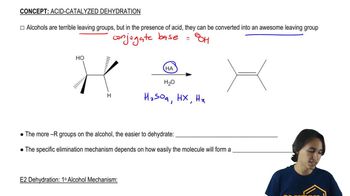
Acid-catalyzed dehydration is a reaction where an alcohol is converted into an alkene through the removal of water, facilitated by an acid. This process involves protonation of the alcohol, leading to the formation of a carbocation intermediate, which can then lose a water molecule. The reaction is reversible, meaning that the alkene can also be converted back into the alcohol under appropriate conditions.
추천 영상:
06:01
General features of acid-catalyzed dehydration.

Mechanism of Alkene Formation

The mechanism for the formation of an alcohol from an alkene typically involves the addition of water across the double bond of the alkene, a process known as hydration. This reaction can occur via either a Markovnikov or anti-Markovnikov pathway, depending on the conditions and the presence of catalysts. The addition of water leads to the formation of a carbocation, which is then attacked by a water molecule, resulting in the formation of the alcohol.
추천 영상:
가이드 코스
1:59
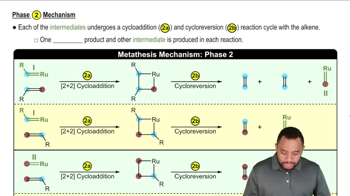
Alkene Metathesis Concept 5

Carbocation Stability

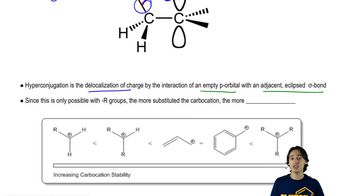
Carbocation stability is a crucial concept in organic chemistry, as it influences the outcome of reactions involving carbocations. Carbocations are positively charged species that can rearrange or react to form more stable structures. The stability of a carbocation increases with the number of alkyl groups attached to the positively charged carbon, following the order: tertiary > secondary > primary. Understanding carbocation stability is essential for predicting the products of reactions involving alkenes and alcohols.
추천 영상:
05:58
Determining Carbocation Stability