Ch. 13 - Alcohols, Ethers and Related Compounds: Substitution and Elimination
Mullins - Organic Chemistry: A Learner Centered Approach 1st Edition
Mullins1st EditionOrganic Chemistry: A Learner Centered ApproachISBN: 9780137566471당신이 사용하는 게 아니라요?교과서 변경
12장, 문제 77

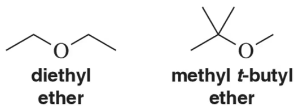
Methyl t-butyl ether (MTBE) is used preferentially over diethyl ether because it is less prone to form peroxides. Explain this observation in terms of the two structures.

검증된 단계별 안내
1
Examine the structures of diethyl ether and methyl t-butyl ether. Diethyl ether has two ethyl groups attached to the oxygen atom, while methyl t-butyl ether has a methyl group and a t-butyl group attached to the oxygen atom.
Consider the steric hindrance around the oxygen atom in both ethers. Methyl t-butyl ether has a bulky t-butyl group, which provides significant steric hindrance compared to the smaller ethyl groups in diethyl ether.
Understand the formation of peroxides in ethers. Peroxides form when ethers react with oxygen, typically at the alpha carbon adjacent to the oxygen atom. The presence of bulky groups can hinder this reaction.
Analyze how steric hindrance affects peroxide formation. The bulky t-butyl group in methyl t-butyl ether makes it difficult for oxygen to approach and react with the ether, reducing the likelihood of peroxide formation.
Conclude that the reduced tendency of methyl t-butyl ether to form peroxides is due to the increased steric hindrance provided by the t-butyl group, which protects the ether from reacting with oxygen.

비슷한 문제에 대한 검증된 영상 답변:

이 영상 해법은 위 문제에 도움이 된다고 튜터들이 추천한 것입니다.
도움이 되었나요?

주요 개념

질문에 올바르게 답하기 위해 반드시 이해해야 하는 핵심 개념들은 다음과 같습니다.

Peroxide Formation

Peroxides are reactive compounds formed when ethers undergo autoxidation, typically in the presence of oxygen. Diethyl ether, due to its structure, is more susceptible to this process, leading to the formation of potentially explosive peroxides. In contrast, methyl t-butyl ether (MTBE) has a branched structure that stabilizes the molecule and reduces the likelihood of peroxide formation.
추천 영상:
02:26
Formation of Enolates

Structure-Activity Relationship

The structure of a molecule significantly influences its chemical reactivity and stability. In the case of MTBE, the presence of a tert-butyl group provides steric hindrance, which limits the accessibility of the ether oxygen to react with oxygen. This contrasts with diethyl ether, where the linear structure allows for easier interaction with oxygen, promoting peroxide formation.
추천 영상:
가이드 코스
4:47
Metal Ion Catalysis: Water Activation Concept 2

Stability of Ethers

Ethers are generally stable compounds, but their stability can vary based on their molecular structure. MTBE's branched structure not only makes it less reactive but also enhances its solubility in organic solvents. This stability is crucial in applications where the formation of hazardous byproducts, like peroxides, must be minimized, making MTBE a safer alternative to diethyl ether.
추천 영상:
03:43
The radical stability trend.