Ch. 13 - Alcohols, Ethers and Related Compounds: Substitution and Elimination
Mullins - Organic Chemistry: A Learner Centered Approach 1st Edition
Mullins1st EditionOrganic Chemistry: A Learner Centered ApproachISBN: 9780137566471당신이 사용하는 게 아니라요?교과서 변경
12장, 문제 59b

Predict the product of the following oxidation reactions.
(b) Cyclopentanol reacts with Dess-Martin reagent, an oxidizing agent, to predict the oxidation product.

검증된 단계별 안내
1
Identify the functional group present in the starting material. Oxidation reactions typically involve alcohols, aldehydes, or ketones. Determine which functional group is present in the compound you are working with.
Select the appropriate oxidizing agent for the reaction. Common oxidizing agents include potassium permanganate (KMnO₄), chromium trioxide (CrO₃), and pyridinium chlorochromate (PCC). The choice of oxidizing agent can affect the outcome of the reaction.
Consider the conditions under which the oxidation is taking place. For example, acidic or basic conditions can influence the reaction pathway and the final product.
Predict the transformation based on the functional group and oxidizing agent. For instance, primary alcohols typically oxidize to aldehydes and then to carboxylic acids, while secondary alcohols oxidize to ketones.
Draw the structure of the expected product, ensuring that you account for any changes in the oxidation state of the carbon atoms involved in the reaction. Use structural formulas to clearly represent the changes.

비슷한 문제에 대한 검증된 영상 답변:

이 영상 해법은 위 문제에 도움이 된다고 튜터들이 추천한 것입니다.
영상 길이:
2m

주요 개념

질문에 올바르게 답하기 위해 반드시 이해해야 하는 핵심 개념들은 다음과 같습니다.

Oxidation Reaction

An oxidation reaction in organic chemistry involves the increase in the oxidation state of a molecule, typically by the addition of oxygen or the removal of hydrogen. This process often converts alcohols to aldehydes, ketones, or carboxylic acids, depending on the type of alcohol and the oxidizing agent used.
추천 영상:
03:20
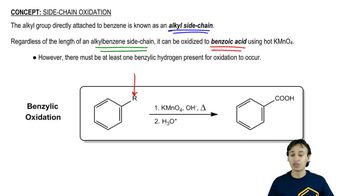
Benzylic Oxidation

Types of Alcohols

Alcohols are classified as primary, secondary, or tertiary based on the number of carbon atoms attached to the carbon bearing the hydroxyl group. Primary alcohols can be oxidized to aldehydes and further to carboxylic acids, secondary alcohols to ketones, while tertiary alcohols generally resist oxidation due to the lack of hydrogen atoms on the carbon.
추천 영상:
01:01
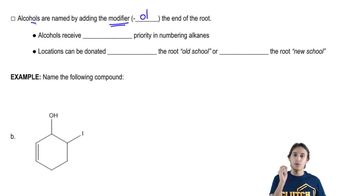
How to name alcohols

Common Oxidizing Agents

Common oxidizing agents in organic chemistry include potassium permanganate (KMnO4), chromium trioxide (CrO3), and pyridinium chlorochromate (PCC). Each agent has specific conditions and selectivity, influencing the outcome of the oxidation reaction, such as PCC being used for mild oxidation to convert primary alcohols to aldehydes without further oxidation to carboxylic acids.
추천 영상:
03:40
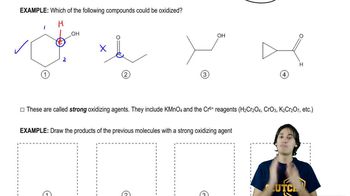
Strong oxidizing agents