Ch. 13 - Alcohols, Ethers and Related Compounds: Substitution and Elimination
Mullins - Organic Chemistry: A Learner Centered Approach 1st Edition
Mullins1st EditionOrganic Chemistry: A Learner Centered ApproachISBN: 9780137566471당신이 사용하는 게 아니라요?교과서 변경
12장, 문제 61b

Predict the product of the following reactions.
(b)

검증된 단계별 안내
1
Identify the functional groups present in the reactant. In this case, the reactant contains a 1,2-diol (vicinal diol) group, which is two hydroxyl groups (-OH) on adjacent carbon atoms.
Recognize the reagent used in the reaction. Here, periodic acid (HIO₄) is used, which is known for cleaving vicinal diols to form carbonyl compounds.
Understand the mechanism of the reaction. Periodic acid cleaves the C-C bond between the two hydroxyl-bearing carbons, resulting in the formation of two carbonyl groups (aldehydes or ketones).
Determine the structure of the product. The cleavage of the C-C bond in the diol will result in the formation of two separate molecules, each containing a carbonyl group where the hydroxyl groups were originally attached.
Consider stereochemistry and any other structural features. Since the reaction involves breaking a bond, the stereochemistry of the original diol does not affect the final carbonyl products, but it is important to ensure the correct placement of the carbonyl groups in the resulting structures.

비슷한 문제에 대한 검증된 영상 답변:

이 영상 해법은 위 문제에 도움이 된다고 튜터들이 추천한 것입니다.

주요 개념

질문에 올바르게 답하기 위해 반드시 이해해야 하는 핵심 개념들은 다음과 같습니다.

Reaction Mechanisms

Understanding reaction mechanisms is crucial in organic chemistry as they describe the step-by-step process by which reactants transform into products. This includes identifying intermediates, transition states, and the movement of electrons. Familiarity with mechanisms helps predict the outcome of reactions and the stability of products formed.
추천 영상:
02:16
Heck Reaction Mechanism

Functional Groups

Functional groups are specific groups of atoms within molecules that are responsible for the characteristic chemical reactions of those molecules. Recognizing functional groups allows chemists to predict reactivity patterns and the types of reactions that can occur. For example, alcohols, carboxylic acids, and amines each have distinct behaviors in chemical reactions.
추천 영상:
02:36
Identifying Functional Groups

Stereochemistry

Stereochemistry involves the study of the spatial arrangement of atoms in molecules and how this affects their chemical behavior. It is essential for predicting the products of reactions, especially in cases where chirality or geometric isomerism is involved. Understanding stereochemistry helps in determining the specific isomers that may be formed during a reaction.
추천 영상:
가이드 코스
1:38
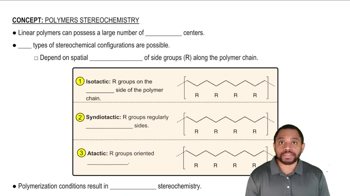
Polymer Stereochemistry Concept 1