Ch. 13 - Alcohols, Ethers and Related Compounds: Substitution and Elimination
Mullins - Organic Chemistry: A Learner Centered Approach 1st Edition
Mullins1st EditionOrganic Chemistry: A Learner Centered ApproachISBN: 9780137566471당신이 사용하는 게 아니라요?교과서 변경
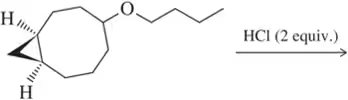
12장, 문제 74b

Predict the products of the following reactions.
(b)

검증된 단계별 안내
1
Identify the type of reaction: Determine whether the reaction is an addition, elimination, substitution, or rearrangement. This will guide the prediction of products.
Analyze the reactants: Look at the structure of the reactants involved in the reaction. Consider functional groups, stereochemistry, and any other relevant features.
Consider reaction conditions: Evaluate the conditions under which the reaction is taking place, such as temperature, solvent, and presence of catalysts, as these can influence the reaction pathway.
Apply mechanistic principles: Use your understanding of organic reaction mechanisms to predict how the reactants will interact. Consider electron flow, intermediates, and transition states.
Predict the products: Based on the type of reaction, reactants, conditions, and mechanistic principles, predict the structure of the products. Ensure to consider regioselectivity and stereoselectivity if applicable.

비슷한 문제에 대한 검증된 영상 답변:

이 영상 해법은 위 문제에 도움이 된다고 튜터들이 추천한 것입니다.

주요 개념

질문에 올바르게 답하기 위해 반드시 이해해야 하는 핵심 개념들은 다음과 같습니다.

Reaction Mechanism

A reaction mechanism is a step-by-step sequence of elementary reactions by which overall chemical change occurs. Understanding the mechanism helps predict the products by showing how reactants are transformed into products through intermediates and transition states. It involves identifying the type of reaction, such as substitution, addition, or elimination, and the role of catalysts or reagents.
추천 영상:
02:16
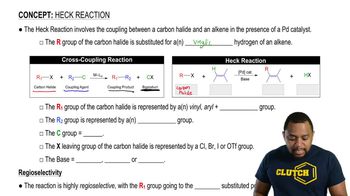
Heck Reaction Mechanism

Functional Groups

Functional groups are specific groups of atoms within molecules that have characteristic properties and reactivity. Recognizing functional groups in reactants is crucial for predicting reaction outcomes, as they determine the types of chemical reactions the molecule can undergo. Common functional groups include alcohols, alkenes, carboxylic acids, and amines, each with distinct reactivity patterns.
추천 영상:
02:36
Identifying Functional Groups

Regioselectivity and Stereoselectivity

Regioselectivity refers to the preference of a chemical reaction to yield one structural isomer over others, while stereoselectivity involves the formation of one stereoisomer over another. These concepts are essential for predicting the major products of reactions, especially in cases involving asymmetric centers or multiple possible reaction sites. Understanding these principles helps in determining the most likely product configuration.
추천 영상:
05:09
Heck Reaction