Ch. 13 - Alcohols, Ethers and Related Compounds: Substitution and Elimination
Mullins - Organic Chemistry: A Learner Centered Approach 1st Edition
Mullins1st EditionOrganic Chemistry: A Learner Centered ApproachISBN: 9780137566471당신이 사용하는 게 아니라요?교과서 변경
12장, 문제 106k(i,ii)

Predict the product(s) that would result when molecules (a)–(p) are allowed to react under the following conditions: (i) SOCl₂ ; (ii) PBr₃. If no reaction occurs, write 'no reaction.'
(k) Chemical structure of a cyclohexanol derivative with an attached hydroxyl group.

검증된 단계별 안내
1
Identify the functional group in the given molecule. The structure shows a cyclohexane ring with a tertiary alcohol group attached.
Consider the reaction with SOCl₂ (thionyl chloride). Tertiary alcohols react with SOCl₂ to form alkyl chlorides. The hydroxyl group (OH) will be replaced by a chlorine atom (Cl).
Consider the stereochemistry of the reaction with SOCl₂. The reaction typically proceeds with retention of configuration, so the stereochemistry at the carbon center will remain the same.
Consider the reaction with PBr₃ (phosphorus tribromide). Tertiary alcohols generally do not react well with PBr₃ due to steric hindrance, so this reaction may not proceed efficiently.
Summarize the expected products: For reaction with SOCl₂, expect a tertiary alkyl chloride with retention of stereochemistry. For reaction with PBr₃, note that the reaction may not occur due to steric hindrance.

비슷한 문제에 대한 검증된 영상 답변:

이 영상 해법은 위 문제에 도움이 된다고 튜터들이 추천한 것입니다.
도움이 되었나요?

주요 개념

질문에 올바르게 답하기 위해 반드시 이해해야 하는 핵심 개념들은 다음과 같습니다.

Thionyl Chloride (SOCl₂) Reactivity

Thionyl chloride is commonly used in organic chemistry to convert alcohols into alkyl chlorides. The reaction involves the nucleophilic substitution mechanism, where the hydroxyl group of the alcohol is replaced by a chloride ion. This process typically results in the formation of an alkyl chloride and byproducts of sulfur dioxide and hydrochloric acid.
추천 영상:
01:36
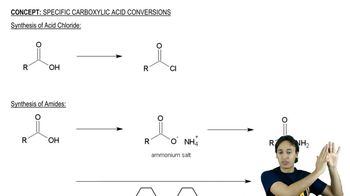
Synthesis of Acid Chlorides

Phosphorus Tribromide (PBr₃) Reactivity

Phosphorus tribromide is another reagent used to convert alcohols into alkyl bromides. Similar to SOCl₂, PBr₃ facilitates a nucleophilic substitution reaction, where the alcohol's hydroxyl group is replaced by a bromine atom. This reaction is particularly useful for converting primary and secondary alcohols into their corresponding bromides efficiently.
추천 영상:
01:17
Reactivity of Molecules

Nucleophilic Substitution Mechanisms

Nucleophilic substitution is a fundamental reaction type in organic chemistry where a nucleophile attacks an electrophile, resulting in the replacement of a leaving group. There are two main mechanisms: SN1, which involves a two-step process with a carbocation intermediate, and SN2, which is a one-step process characterized by a concerted reaction. Understanding these mechanisms is crucial for predicting the outcomes of reactions involving various substrates and reagents.
추천 영상:
01:47
Nucleophiles and Electrophiles can react in Substitution Reactions.
관련 실천
교과서 질문

Predict the product(s) that would result when molecules (a)–(p) are allowed to react under the following conditions: (xi) HOCl, H2O (xii) HIO4 If no reaction occurs, write 'no reaction.'


(k)

715
views

교과서 질문

Predict the product(s) that would result when molecules (a)–(p) are allowed to react under the following conditions: (v) 1. TsCl, Et₃N 2. NaOt-Bu (vi) H₂SO₄ If no reaction occurs, write 'no reaction.'

(k)

784
views
교과서 질문

Predict the product(s) that would result when molecules (a)–(p) are allowed to react under the following conditions: (iii) SOCl₂ , NEt₃, and (iv) 1. TsCl, Et₃N 2. NaCN. If no reaction occurs, write 'no reaction.'

(k)

560
views
교과서 질문

Predict the product(s) that would result when molecules (a)–(p) are allowed to react under the following conditions:(vii) HCl; (viii) HBr If no reaction occurs, write 'no reaction.'


(k)

726
views
교과서 질문

Predict the product(s) that would result when molecules (a)–(p) are allowed to react under the following conditions: (i) SOCl₂ ; (ii) PBr₃ ; (iii) SOCl₂ , NEt₃ (iv) 1. TsCl, Et₃N 2. NaCN; (v) 1. TsCl, Et₃N 2. NaOt-Bu (vi) H₂SO₄ (vii) HCl; (viii) HBr; (ix) PCC; (x) H₂CrO₄ , H₂O (xi) HOCl, H₂O (xii) HIO₄ If no reaction occurs, write 'no reaction.'


(f)

805
views
교과서 질문

Predict the product(s) that would result when molecules (a)–(p) are allowed to react under the following conditions: (xi) HOCl, H₂O (xii) HIO₄ If no reaction occurs, write 'no reaction.'

(f)

690
views