Ch. 13 - Alcohols, Ethers and Related Compounds: Substitution and Elimination
Mullins - Organic Chemistry: A Learner Centered Approach 1st Edition
Mullins1st EditionOrganic Chemistry: A Learner Centered ApproachISBN: 9780137566471당신이 사용하는 게 아니라요?교과서 변경
12장, 문제 106f(ix,x)

Predict the product(s) that would result when molecules (a)–(p) are allowed to react under the following conditions: (ix) PCC; (x) H₂CrO₄ , H₂O If no reaction occurs, write 'no reaction.'
(f) Chemical structure of a phenol with a hydroxyl group (OH) attached to a benzene ring.

검증된 단계별 안내
1
Identify the structure of the given molecule. The image shows a tertiary alcohol, specifically 2-methyl-2-phenylpropan-2-ol.
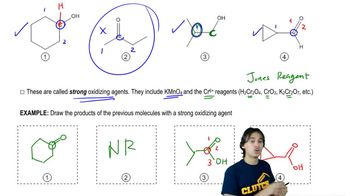
Understand the reagents: PCC (Pyridinium chlorochromate) is a mild oxidizing agent that typically oxidizes primary alcohols to aldehydes and secondary alcohols to ketones. H₂CrO₄ (chromic acid) is a strong oxidizing agent that can oxidize primary alcohols to carboxylic acids and secondary alcohols to ketones.
Recognize that tertiary alcohols, like the one in the image, generally do not undergo oxidation with either PCC or H₂CrO₄ because there is no hydrogen atom on the carbon bearing the hydroxyl group to be removed during the oxidation process.
Predict the outcome for reaction (ix) with PCC: Since the molecule is a tertiary alcohol, no reaction will occur because PCC cannot oxidize tertiary alcohols.
Predict the outcome for reaction (x) with H₂CrO₄, H₂O: Similarly, no reaction will occur with H₂CrO₄ as it also cannot oxidize tertiary alcohols.

비슷한 문제에 대한 검증된 영상 답변:

이 영상 해법은 위 문제에 도움이 된다고 튜터들이 추천한 것입니다.
도움이 되었나요?

주요 개념

질문에 올바르게 답하기 위해 반드시 이해해야 하는 핵심 개념들은 다음과 같습니다.

PCC (Pyridinium Chlorochromate)

PCC is a mild oxidizing agent commonly used in organic chemistry to convert primary alcohols to aldehydes and secondary alcohols to ketones without over-oxidation. It is favored for its ability to selectively oxidize alcohols while minimizing side reactions, making it useful in synthetic pathways where specific functional groups need to be preserved.
추천 영상:
05:53
Strong oxidizing agents

H₂CrO₄ (Chromic Acid)

H₂CrO₄ is a strong oxidizing agent that can oxidize primary alcohols to carboxylic acids and secondary alcohols to ketones. Its reactivity is higher than that of PCC, which means it can lead to over-oxidation if not controlled. Understanding its reactivity is crucial for predicting the outcomes of reactions involving alcohols and other functional groups.
추천 영상:
02:10
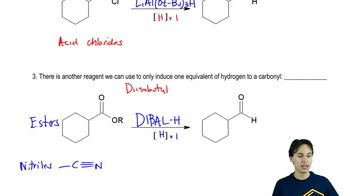
DIBAL-H on Esters and Nitriles

Oxidation States and Functional Group Transformations

In organic chemistry, oxidation refers to the increase in oxidation state of a molecule, often involving the addition of oxygen or the removal of hydrogen. Recognizing how different reagents affect the oxidation states of functional groups is essential for predicting reaction products. This concept helps in understanding how alcohols can be transformed into aldehydes, ketones, or carboxylic acids depending on the oxidizing agent used.
추천 영상:
02:36
Identifying Functional Groups
관련 실천
교과서 질문

Predict the product(s) that would result when molecules (a)–(p) are allowed to react under the following conditions:(vii) HCl; (viii) HBr If no reaction occurs, write 'no reaction.'


(k)

726
views

교과서 질문

Predict the product(s) that would result when molecules (a)–(p) are allowed to react under the following conditions: (i) SOCl₂ ; (ii) PBr₃ ; (iii) SOCl₂ , NEt₃ (iv) 1. TsCl, Et₃N 2. NaCN; (v) 1. TsCl, Et₃N 2. NaOt-Bu (vi) H₂SO₄ (vii) HCl; (viii) HBr; (ix) PCC; (x) H₂CrO₄ , H₂O (xi) HOCl, H₂O (xii) HIO₄ If no reaction occurs, write 'no reaction.'


(f)

805
views
교과서 질문

Predict the product(s) that would result when molecules (a)–(p) are allowed to react under the following conditions: (iii) SOCl₂ , NEt₃ (iv) 1. TsCl, Et₃N 2. NaCN; If no reaction occurs, write 'no reaction.'

(f)

823
views
교과서 질문

Predict the product(s) that would result when molecules (a)–(p) are allowed to react under the following conditions: (vii) HCl; (viii) HBr; If no reaction occurs, write 'no reaction.'

(f)

744
views
교과서 질문

Predict the product(s) that would result when molecules (a)–(p) are allowed to react under the following conditions: (xi) HOCl, H₂O (xii) HIO₄ If no reaction occurs, write 'no reaction.'

(f)

690
views
교과서 질문

Predict the product(s) that would result when molecules (a)–(p) are allowed to react under the following conditions: (v) 1. TsCl, Et₃N 2. NaOt-Bu (vi) H₂SO₄ If no reaction occurs, write 'no reaction.'

(f)

730
views