Ch. 13 - Alcohols, Ethers and Related Compounds: Substitution and Elimination
Mullins - Organic Chemistry: A Learner Centered Approach 1st Edition
Mullins1st EditionOrganic Chemistry: A Learner Centered ApproachISBN: 9780137566471당신이 사용하는 게 아니라요?교과서 변경
12장, 문제 97f

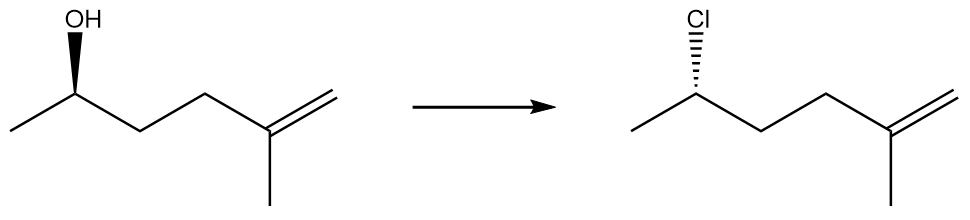
Suggest the appropriate reagents to carry out the following transformations.
(f) Chemical transformation from an alcohol to an alkyl chloride with reagents indicated.

검증된 단계별 안내
1
Identify the functional group transformation: The starting material is an alcohol, and the product is a chloride. This suggests a substitution reaction where the hydroxyl group (OH) is replaced by a chlorine atom (Cl).
Consider the stereochemistry: The starting alcohol has a specific stereochemistry, indicated by the wedge bond, and the product maintains this stereochemistry with the chlorine atom. This suggests the use of a reagent that can perform a stereospecific substitution.
Select an appropriate reagent: Thionyl chloride (SOCl₂) is commonly used for converting alcohols to chlorides while retaining stereochemistry. It reacts with alcohols to form alkyl chlorides, often with retention of configuration.
Outline the reaction mechanism: The reaction with thionyl chloride typically involves the formation of an intermediate chlorosulfite, followed by the departure of sulfur dioxide (SO₂) and chloride ion, resulting in the formation of the alkyl chloride.
Consider reaction conditions: The reaction with thionyl chloride is usually carried out in the presence of a base, such as pyridine, to facilitate the reaction and neutralize any acidic byproducts.

비슷한 문제에 대한 검증된 영상 답변:

이 영상 해법은 위 문제에 도움이 된다고 튜터들이 추천한 것입니다.
영상 길이:
1m

주요 개념

질문에 올바르게 답하기 위해 반드시 이해해야 하는 핵심 개념들은 다음과 같습니다.

Alcohols and Their Reactivity

Alcohols are organic compounds containing a hydroxyl (-OH) group. They can undergo various reactions, including substitution and elimination. Understanding the reactivity of alcohols is crucial for predicting their transformations, such as converting them into alkyl halides.
추천 영상:
01:01
How to name alcohols

Nucleophilic Substitution Reactions

Nucleophilic substitution reactions involve the replacement of a leaving group by a nucleophile. In the case of alcohols, the hydroxyl group can be replaced by a halide ion (like Cl-) through a nucleophilic substitution mechanism, typically facilitated by reagents such as thionyl chloride (SOCl2) or phosphorus trichloride (PCl3).
추천 영상:
01:47
Nucleophiles and Electrophiles can react in Substitution Reactions.

Reagents for Halogenation

Specific reagents are required to convert alcohols into alkyl halides. Common reagents include thionyl chloride (SOCl2) and phosphorus tribromide (PBr3) for chlorination and bromination, respectively. These reagents activate the alcohol, allowing for the efficient substitution of the hydroxyl group with a halogen.
추천 영상:
03:45
Halogenation Mechanism