Ch. 13 - Alcohols, Ethers and Related Compounds: Substitution and Elimination
Mullins - Organic Chemistry: A Learner Centered Approach 1st Edition
Mullins1st EditionOrganic Chemistry: A Learner Centered ApproachISBN: 9780137566471당신이 사용하는 게 아니라요?교과서 변경
12장, 문제 92b

Using an appropriate tosylate intermediate, synthesize the following molecules starting from the appropriate alcohol.
(b)

검증된 단계별 안내
1
Identify the starting alcohol: Analyze the target molecule to determine the appropriate alcohol that can be used as the starting material. The target molecule contains a thioether linkage, suggesting that the alcohol should be a primary alcohol with a similar carbon skeleton.
Convert the alcohol to a tosylate: React the identified alcohol with p-toluenesulfonyl chloride (TsCl) in the presence of a base like pyridine. This will convert the alcohol into a tosylate, which is a good leaving group.
Perform nucleophilic substitution: Use a thiol (R-SH) as the nucleophile to perform a nucleophilic substitution reaction on the tosylate. The thiol will replace the tosylate group, forming the thioether linkage present in the target molecule.
Ensure the correct carbon skeleton: Verify that the carbon skeleton of the starting alcohol matches the target molecule. If necessary, adjust the carbon chain length or branching before tosylation to ensure the final product has the correct structure.
Check stereochemistry and functional groups: Ensure that any stereochemistry or additional functional groups in the target molecule are correctly represented in the final product. Adjust the synthesis steps if needed to achieve the desired configuration.

비슷한 문제에 대한 검증된 영상 답변:

이 영상 해법은 위 문제에 도움이 된다고 튜터들이 추천한 것입니다.
영상 길이:
3m
도움이 되었나요?

주요 개념

질문에 올바르게 답하기 위해 반드시 이해해야 하는 핵심 개념들은 다음과 같습니다.

Tosylate Formation

Tosylates are formed by reacting an alcohol with tosyl chloride (TsCl) in the presence of a base. This reaction converts the alcohol into a better leaving group, the tosylate, which can facilitate nucleophilic substitution reactions. Understanding this transformation is crucial for synthesizing target molecules from alcohols.
추천 영상:
02:26
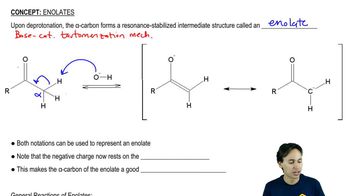
Formation of Enolates

Nucleophilic Substitution Reactions

Nucleophilic substitution reactions involve the replacement of a leaving group in a molecule with a nucleophile. There are two main mechanisms: SN1, which is unimolecular and involves carbocation formation, and SN2, which is bimolecular and involves a direct attack by the nucleophile. Recognizing which mechanism to apply is essential for predicting the outcome of the synthesis.
추천 영상:
01:47
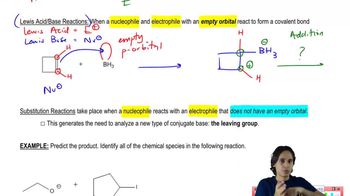
Nucleophiles and Electrophiles can react in Substitution Reactions.

Stereochemistry in Organic Synthesis

Stereochemistry refers to the spatial arrangement of atoms in molecules and is critical in organic synthesis, especially when creating chiral centers. The configuration of the starting materials and the reaction conditions can lead to different stereoisomers. Understanding how to control stereochemistry is vital for synthesizing specific target molecules with desired properties.
추천 영상:
가이드 코스
1:38
Polymer Stereochemistry Concept 1