
Ch. 14 - Structural Identification 1: Infrared Spectroscopy and Mass Spectrometry
Mullins - Organic Chemistry: A Learner Centered Approach 1st Edition
Mullins1st EditionOrganic Chemistry: A Learner Centered ApproachISBN: 9780137566471당신이 사용하는 게 아니라요?교과서 변경
13장, 문제 62b

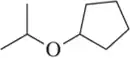
For each of the molecules shown, predict the structure of at least one major fragment in the mass spectrum.
(b) Chemical structure of isopropyl cyclopentyl ether, showing a cyclopentane ring connected to an isopropyl group via an oxygen atom.

검증된 단계별 안내
1
Identify the molecular ion peak (M+) in the mass spectrum, which corresponds to the molecular weight of the compound. This peak is crucial for determining the possible fragments.
Consider the possible cleavage points in the molecule. In organic molecules, common fragmentation patterns include the breaking of C-C bonds, especially those adjacent to functional groups, and the loss of small stable molecules like H2O, CO, or NH3.
Analyze the stability of the potential fragments. More stable carbocations or radicals are more likely to appear as major fragments. For example, tertiary carbocations are more stable than secondary or primary ones.
Use the nitrogen rule, if applicable, to determine the presence of nitrogen in the molecule. This rule states that a molecule with an odd mass number likely contains an odd number of nitrogen atoms.
Predict the structure of the major fragment by considering the most stable cation or radical that can be formed from the molecule. Draw the structure of this fragment, ensuring that it corresponds to a peak in the mass spectrum.

비슷한 문제에 대한 검증된 영상 답변:

이 영상 해법은 위 문제에 도움이 된다고 튜터들이 추천한 것입니다.

주요 개념

질문에 올바르게 답하기 위해 반드시 이해해야 하는 핵심 개념들은 다음과 같습니다.

Mass Spectrometry

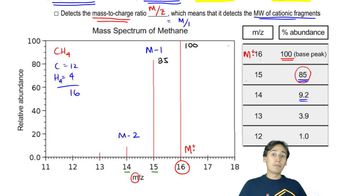
Mass spectrometry is an analytical technique used to measure the mass-to-charge ratio of ions. It helps identify the composition of a sample by generating a mass spectrum, which displays the masses of fragments. Understanding how molecules break apart and form ions is crucial for predicting major fragments in a mass spectrum.
추천 영상:
01:25
How to Read a Mass Spectrum

Fragmentation Patterns

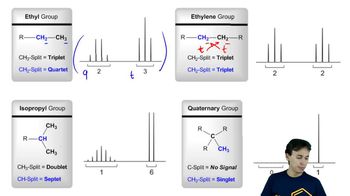
Fragmentation patterns refer to the specific ways in which a molecule breaks apart into smaller ions during mass spectrometry. These patterns are influenced by the molecule's structure and the stability of the resulting fragments. Recognizing common fragmentation pathways, such as cleavage at functional groups, aids in predicting major fragments.
추천 영상:
08:06
Common Splitting Patterns

Stability of Carbocations

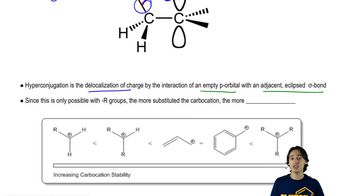
The stability of carbocations plays a significant role in determining fragmentation patterns in mass spectrometry. More stable carbocations, such as tertiary over primary, are more likely to form as major fragments. Understanding the factors that stabilize carbocations, like hyperconjugation and resonance, is essential for predicting which fragments will appear prominently in the spectrum.
추천 영상:
05:58
Determining Carbocation Stability