Ch. 14 - Structural Identification 1: Infrared Spectroscopy and Mass Spectrometry
Mullins - Organic Chemistry: A Learner Centered Approach 1st Edition
Mullins1st EditionOrganic Chemistry: A Learner Centered ApproachISBN: 9780137566471당신이 사용하는 게 아니라요?교과서 변경
13장, 문제 54

Under acidic conditions, alkene A can be isomerized to the more stable alkene B. How could IR spectroscopy be used to distinguish between A and B? [There are a few correct answers.]
Chemical reaction showing isomerization of alkene A to alkene B using H2SO4.

검증된 단계별 안내
1
Identify the structural differences between alkene A and alkene B. Typically, isomerization involves changes in the position of the double bond or the configuration around it.
Understand that IR spectroscopy is used to identify functional groups based on characteristic absorption bands. Alkenes typically show C=C stretching vibrations.
Determine the IR absorption range for C=C stretching vibrations, which is usually around 1600-1680 cm-1. The exact position can vary depending on the substitution pattern of the alkene.
Consider that the stability of alkenes can affect the C=C stretching frequency. More substituted alkenes (like alkene B, if it is more stable) might show a shift in the C=C stretching frequency compared to less substituted alkenes (like alkene A).
Use IR spectroscopy to compare the C=C stretching frequencies of alkene A and alkene B. Look for shifts or changes in intensity that could indicate differences in substitution or conjugation, helping to distinguish between the two isomers.

비슷한 문제에 대한 검증된 영상 답변:

이 영상 해법은 위 문제에 도움이 된다고 튜터들이 추천한 것입니다.

주요 개념

질문에 올바르게 답하기 위해 반드시 이해해야 하는 핵심 개념들은 다음과 같습니다.

Alkene Isomerization

Alkene isomerization involves the rearrangement of atoms within an alkene molecule, often resulting in a more stable configuration. Under acidic conditions, this process can shift the position of double bonds or alter the geometry, leading to a more thermodynamically favorable isomer. Understanding the stability of alkenes is crucial for predicting the outcome of isomerization reactions.
추천 영상:
06:47
Monosaccharides - D and L Isomerism

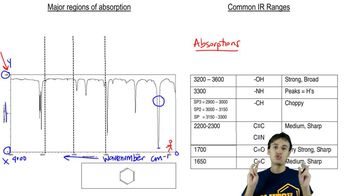
Infrared (IR) Spectroscopy

IR spectroscopy is a technique used to identify functional groups in organic compounds by measuring the absorption of infrared light. Different bonds absorb specific frequencies, creating a spectrum that can be analyzed to determine molecular structure. For alkenes, the C=C stretching vibration typically appears around 1600-1680 cm⁻¹, allowing differentiation between isomers based on subtle shifts in these peaks.
추천 영상:
16:04
General Features of IR Spect

Alkene Stability

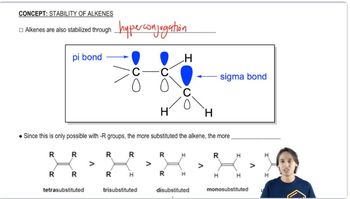
Alkene stability is influenced by factors such as the degree of substitution and the geometry of the double bond. More substituted alkenes are generally more stable due to hyperconjugation and the electron-donating effects of alkyl groups. Additionally, trans alkenes are often more stable than cis due to reduced steric hindrance. Recognizing these stability trends helps predict which isomer will be favored under certain conditions.
추천 영상:
04:28
Understanding trends of alkene stability.