Ch. 14 - Structural Identification 1: Infrared Spectroscopy and Mass Spectrometry
Mullins - Organic Chemistry: A Learner Centered Approach 1st Edition
Mullins1st EditionOrganic Chemistry: A Learner Centered ApproachISBN: 9780137566471당신이 사용하는 게 아니라요?교과서 변경
13장, 문제 51

A carboxylic acid can be converted to an ester using the conditions shown. Explain how a comparison of an IR spectrum of the reactant(s) and product can be used to determine whether the reaction was successful or not.
Chemical reaction: carboxylic acid and alcohol form an ester and water, using H2SO4 as a catalyst.

검증된 단계별 안내
1
Identify the functional groups present in the reactant (carboxylic acid) and the product (ester). Carboxylic acids have a characteristic C=O stretch around 1700 cm-1 and an O-H stretch around 2500-3300 cm-1 in their IR spectrum.
Recognize that esters have a C=O stretch similar to carboxylic acids, but they lack the broad O-H stretch. Instead, esters show a C-O stretch typically in the range of 1050-1300 cm-1.
Compare the IR spectrum of the reactant with that of the product. Look for the disappearance of the broad O-H stretch in the product's spectrum, which indicates the loss of the carboxylic acid's hydroxyl group.
Check for the presence of the ester C-O stretch in the product's IR spectrum, which should appear as a new peak compared to the reactant's spectrum.
Conclude that the reaction was successful if the IR spectrum of the product shows the disappearance of the O-H stretch and the appearance of the C-O stretch, confirming the conversion of the carboxylic acid to an ester.

비슷한 문제에 대한 검증된 영상 답변:

이 영상 해법은 위 문제에 도움이 된다고 튜터들이 추천한 것입니다.

주요 개념

질문에 올바르게 답하기 위해 반드시 이해해야 하는 핵심 개념들은 다음과 같습니다.

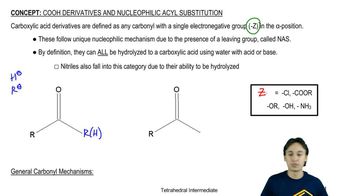
Carboxylic Acid to Ester Conversion

The conversion of a carboxylic acid to an ester typically involves a reaction with an alcohol in the presence of an acid catalyst, known as esterification. This process replaces the hydroxyl group (-OH) of the carboxylic acid with an alkoxy group (-OR) from the alcohol, forming an ester and water as byproducts.
추천 영상:
03:50
Intro to Carboxylic Acid Derivatives

Infrared (IR) Spectroscopy

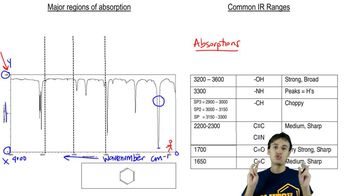
IR spectroscopy is a technique used to identify functional groups in organic compounds by measuring the absorption of infrared light. Different functional groups absorb specific frequencies, creating a spectrum that can be analyzed to determine the presence or absence of particular bonds, such as the carbonyl group in carboxylic acids and esters.
추천 영상:
16:04
General Features of IR Spect

Functional Group Identification via IR Spectrum

In the IR spectrum, carboxylic acids show a broad O-H stretch around 2500-3000 cm⁻¹ and a sharp C=O stretch near 1700 cm⁻¹. Esters, however, lack the O-H stretch and exhibit a C=O stretch around 1735-1750 cm⁻¹. Comparing these spectra allows one to confirm the conversion by the disappearance of the O-H stretch and the shift in the C=O stretch.
추천 영상:
04:04
Drawing Concealed Functional Groups