Ch. 14 - Structural Identification 1: Infrared Spectroscopy and Mass Spectrometry
Mullins - Organic Chemistry: A Learner Centered Approach 1st Edition
Mullins1st EditionOrganic Chemistry: A Learner Centered ApproachISBN: 9780137566471당신이 사용하는 게 아니라요?교과서 변경
13장, 문제 47b

Choose the bond in each pair that you expect to have the more intense stretching band
(b) C=O vs. C=N

검증된 단계별 안내
1
Identify the type of bonds in question: C=O (carbon-oxygen double bond) and C=N (carbon-nitrogen double bond).
Understand that the intensity of an IR stretching band is influenced by the dipole moment change during the vibration. A greater change in dipole moment results in a more intense band.
Consider the electronegativity of the atoms involved: Oxygen is more electronegative than nitrogen, which means the C=O bond will have a greater dipole moment compared to the C=N bond.
Recognize that the greater the difference in electronegativity between the bonded atoms, the more polar the bond, and thus, the more intense the IR absorption band.
Conclude that the C=O bond is expected to have a more intense stretching band than the C=N bond due to the higher dipole moment change during vibration.

비슷한 문제에 대한 검증된 영상 답변:

이 영상 해법은 위 문제에 도움이 된다고 튜터들이 추천한 것입니다.

주요 개념

질문에 올바르게 답하기 위해 반드시 이해해야 하는 핵심 개념들은 다음과 같습니다.

Infrared Spectroscopy

Infrared (IR) spectroscopy is a technique used to identify functional groups in organic molecules by measuring the absorption of infrared light, which causes molecular vibrations. The intensity of the absorption band in an IR spectrum is related to the change in dipole moment during the vibration. A greater change in dipole moment results in a more intense absorption band.
추천 영상:
가이드 코스
2:56
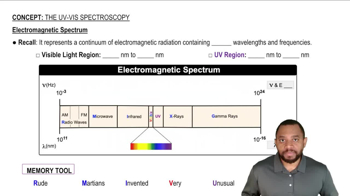
The UV-Vis Spectroscopy Concept 1

Dipole Moment

The dipole moment is a measure of the separation of positive and negative charges in a molecule. It is a vector quantity, with both magnitude and direction, and is crucial in determining the intensity of IR absorption bands. Bonds with larger dipole moments typically exhibit more intense stretching bands in IR spectroscopy due to greater changes in dipole moment during vibration.
추천 영상:
01:46
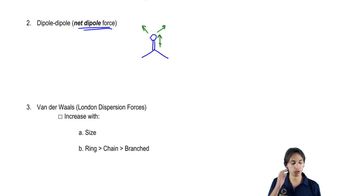
How dipole-dipole forces work.

Bond Polarity and Electronegativity

Bond polarity arises from differences in electronegativity between two bonded atoms, leading to an uneven distribution of electron density. In the context of IR spectroscopy, more polar bonds, such as C=O, tend to have more intense stretching bands compared to less polar bonds like C=N, due to the larger change in dipole moment during vibration.
추천 영상:
1:47
Electronegativity