Ch. 15 - Structural Identification 2: Nuclear Magnetic Resonance Spectroscopy
Mullins - Organic Chemistry: A Learner Centered Approach 1st Edition
Mullins1st EditionOrganic Chemistry: A Learner Centered ApproachISBN: 9780137566471당신이 사용하는 게 아니라요?교과서 변경
14장, 문제 59e

For the following molecules, give the chemical shift for each indicated hydrogen.
(e) Chemical structure showing ester with labeled hydrogens: H2 on CH2 group and H1 on CH3 group.

검증된 단계별 안내
1
Identify the molecular structure and locate the hydrogen atoms for which the chemical shift needs to be determined. This involves understanding the environment around each hydrogen atom, including nearby atoms and functional groups.
Consider the electronic environment of each hydrogen atom. Chemical shifts in NMR spectroscopy are influenced by the electron density around the hydrogen. Electronegative atoms or groups can deshield the hydrogen, causing a downfield shift (higher ppm value).
Analyze the hybridization of the carbon atom to which the hydrogen is attached. For example, hydrogens attached to sp3 hybridized carbons typically appear upfield (lower ppm), while those attached to sp2 or sp hybridized carbons appear downfield.
Take into account any aromatic or conjugated systems. Hydrogens in aromatic systems, such as benzene rings, often appear in a distinct chemical shift range due to the ring current effect.
Use reference tables or literature values to estimate the chemical shift range for each type of hydrogen in the molecule. Compare the environments of the hydrogens in your molecule to these standard values to predict their chemical shifts.

비슷한 문제에 대한 검증된 영상 답변:

이 영상 해법은 위 문제에 도움이 된다고 튜터들이 추천한 것입니다.
도움이 되었나요?

주요 개념

질문에 올바르게 답하기 위해 반드시 이해해야 하는 핵심 개념들은 다음과 같습니다.

Chemical Shift

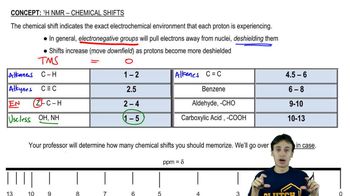
Chemical shift refers to the position on the NMR spectrum where a particular hydrogen atom resonates. It is influenced by the electronic environment surrounding the hydrogen, which affects its magnetic field. The chemical shift is measured in parts per million (ppm) and provides insights into the structure and functional groups present in the molecule.
추천 영상:
11:44
1H NMR Chemical Shifts

Shielding and Deshielding

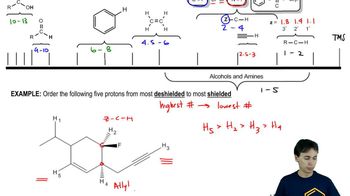
Shielding occurs when electrons around a hydrogen atom create a local magnetic field that opposes the external magnetic field, resulting in a lower chemical shift. Deshielding happens when the electron density is reduced, often due to electronegative atoms or groups, leading to a higher chemical shift. Understanding these effects is crucial for predicting chemical shifts in NMR spectroscopy.
추천 영상:
04:18
Ranking Shielded Protons

Functional Groups and Their Influence

Functional groups significantly impact the chemical shift of hydrogens in a molecule. For instance, hydrogens attached to carbon atoms near electronegative atoms or within aromatic rings typically exhibit higher chemical shifts due to deshielding. Recognizing the presence and type of functional groups helps in estimating the chemical shift values accurately.
추천 영상:
02:36
Identifying Functional Groups