Ch. 15 - Structural Identification 2: Nuclear Magnetic Resonance Spectroscopy
Mullins - Organic Chemistry: A Learner Centered Approach 1st Edition
Mullins1st EditionOrganic Chemistry: A Learner Centered ApproachISBN: 9780137566471당신이 사용하는 게 아니라요?교과서 변경
14장, 문제 60f

Predict the splitting pattern for each of the indicated hydrogens in Assessment 15.59.
(f) Chemical structure with labeled hydrogens: H1, H2, H3, for predicting spin-splitting patterns in 1H NMR analysis.

검증된 단계별 안내
1
Identify the type of hydrogen atoms in the molecule. Look for different environments such as alkyl, alkenyl, aromatic, etc., and note the number of hydrogen atoms in each environment.
Determine the number of neighboring hydrogen atoms for each type of hydrogen. This is crucial for predicting the splitting pattern, as the number of neighboring hydrogens (n) will influence the multiplicity of the signal.
Apply the n+1 rule to predict the splitting pattern. According to this rule, the number of peaks in the NMR signal is equal to the number of neighboring hydrogens plus one. For example, if a hydrogen has 2 neighboring hydrogens, its signal will be a triplet (2+1=3).
Consider any special cases such as equivalent hydrogens or coupling constants. Equivalent hydrogens will not split each other, and coupling constants can affect the appearance of the splitting pattern.
Review the chemical structure for symmetry or other factors that might affect the splitting pattern. Symmetrical molecules may have fewer unique signals due to equivalent environments.

비슷한 문제에 대한 검증된 영상 답변:

이 영상 해법은 위 문제에 도움이 된다고 튜터들이 추천한 것입니다.
도움이 되었나요?

주요 개념

질문에 올바르게 답하기 위해 반드시 이해해야 하는 핵심 개념들은 다음과 같습니다.

NMR Spectroscopy

Nuclear Magnetic Resonance (NMR) Spectroscopy is a technique used to determine the structure of organic compounds by observing the magnetic properties of certain atomic nuclei. In NMR, the splitting pattern of hydrogen signals provides information about the number of neighboring hydrogen atoms, which helps in deducing the molecular structure.
추천 영상:
10:06
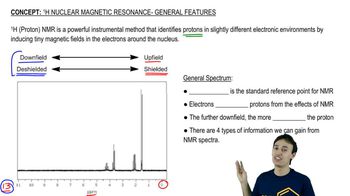
General NMR Features

Spin-Spin Coupling

Spin-spin coupling, also known as J-coupling, occurs when the magnetic field of one nucleus affects the magnetic field of a neighboring nucleus. This interaction causes the splitting of NMR signals into multiplets, with the number of peaks in a multiplet indicating the number of adjacent hydrogens plus one (n+1 rule).
추천 영상:
02:54
Sonogashira Coupling Reaction

Multiplicity

Multiplicity refers to the number of peaks observed in an NMR signal due to spin-spin coupling. It is determined by the n+1 rule, where 'n' is the number of neighboring hydrogens. Common multiplicities include singlets, doublets, triplets, and quartets, each providing insights into the molecular environment of the hydrogen atoms.
추천 영상:
가이드 코스
1:41
Primary Structure of Nucleic Acids Concept 1