Ch. 17 - Carbonyl Addition Reactions: Aldehydes and Ketones
Mullins - Organic Chemistry: A Learner Centered Approach 1st Edition
Mullins1st EditionOrganic Chemistry: A Learner Centered ApproachISBN: 9780137566471당신이 사용하는 게 아니라요?교과서 변경
16장, 문제 67

As discussed in Section 17.9.1, alkenes can be hydrogenated selectively in the presence of ketones. Suppose that was not the case, and suggest how you might use a protecting group strategy to generate A from B.
Chemical structures labeled A and B, showing a transformation over three steps, with carbonyl groups indicated.

검증된 단계별 안내
1
Identify the functional groups in compound B. It contains an alkene and a ketone group. The goal is to selectively hydrogenate the alkene without affecting the ketone.
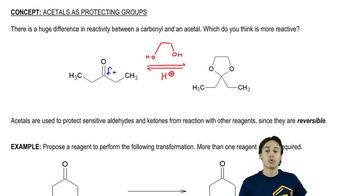
Consider using a protecting group strategy to shield the ketone from hydrogenation conditions. A common protecting group for ketones is the acetal, which can be formed by reacting the ketone with a diol under acidic conditions.
React compound B with a diol, such as ethylene glycol, in the presence of an acid catalyst to form the acetal protecting group. This will temporarily convert the ketone into an acetal, which is stable under hydrogenation conditions.
Perform the hydrogenation reaction on the alkene. Use a catalyst like palladium on carbon (Pd/C) under hydrogen gas to selectively reduce the alkene to an alkane while the ketone is protected as an acetal.
Finally, remove the acetal protecting group by hydrolysis. Treat the compound with aqueous acid to regenerate the ketone from the acetal, yielding compound A.

비슷한 문제에 대한 검증된 영상 답변:

이 영상 해법은 위 문제에 도움이 된다고 튜터들이 추천한 것입니다.
영상 길이:
2m

주요 개념

질문에 올바르게 답하기 위해 반드시 이해해야 하는 핵심 개념들은 다음과 같습니다.

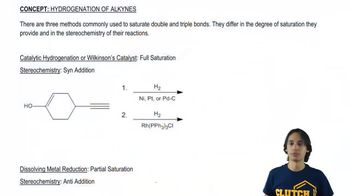
Hydrogenation of Alkenes

Hydrogenation is a chemical reaction that involves the addition of hydrogen (H2) to an alkene, converting it into an alkane. This process typically requires a catalyst, such as palladium or platinum, and can be selective, meaning it can target specific double bonds in the presence of other functional groups. Understanding the conditions and selectivity of hydrogenation is crucial for manipulating alkenes in organic synthesis.
추천 영상:
00:48
The definition of hydrogenation.

Protecting Groups

Protecting groups are temporary modifications used in organic synthesis to shield reactive functional groups from undesired reactions during a multi-step synthesis. By selectively protecting certain groups, chemists can control the reactivity of molecules, allowing for specific transformations without interference. This strategy is essential when dealing with complex molecules that contain multiple functional groups.
추천 영상:
02:44
Protecting Groups

Functional Group Interconversion

Functional group interconversion refers to the process of transforming one functional group into another within a molecule. This concept is fundamental in organic chemistry as it allows chemists to modify the reactivity and properties of compounds. Understanding how to effectively perform these conversions is key to designing synthetic pathways, especially when protecting groups are involved.
추천 영상:
02:36
Identifying Functional Groups