Ch. 19 - Nucleophilic Acyl Substitution 2: Carboxylic Acid Derivatives
Mullins - Organic Chemistry: A Learner Centered Approach 1st Edition
Mullins1st EditionOrganic Chemistry: A Learner Centered ApproachISBN: 9780137566471당신이 사용하는 게 아니라요?교과서 변경
18장, 문제 54

Beginning with an amide, two different pathways produce the same compound. Predict the product of these two pathways.
Chemical reaction pathways from amide to same product using P2O5, Li, H2SO4, H2O, SOCl2, and LiCu reagents.

검증된 단계별 안내
1
Step 1: Understand the structure of an amide. An amide is a functional group characterized by a carbonyl group (C=O) linked to a nitrogen atom (N). The general formula is R-C(=O)-NR2, where R can be a hydrogen or an organic substituent.
Step 2: Identify the two pathways that can transform an amide into the same product. Common pathways include hydrolysis and reduction. Hydrolysis involves breaking the amide bond using water, while reduction involves adding hydrogen to the amide.
Step 3: For the hydrolysis pathway, consider the reaction of the amide with water in the presence of an acid or base catalyst. This typically results in the formation of a carboxylic acid and an amine. The reaction can be represented as: R1-C(=O)NR2+H2O→R1-C(=O)OH+R2NH2
Step 4: For the reduction pathway, consider the reaction of the amide with a reducing agent such as lithium aluminum hydride (LiAlH4). This typically results in the formation of an amine. The reaction can be represented as: R1-C(=O)NR2+LiAlH44→R1CH22NHR2
Step 5: Compare the products of both pathways. In this case, both pathways lead to the formation of an amine, which is the common product. The hydrolysis pathway produces an amine along with a carboxylic acid, while the reduction pathway directly produces an amine.

비슷한 문제에 대한 검증된 영상 답변:

이 영상 해법은 위 문제에 도움이 된다고 튜터들이 추천한 것입니다.

주요 개념

질문에 올바르게 답하기 위해 반드시 이해해야 하는 핵심 개념들은 다음과 같습니다.

Amide Structure and Reactivity

Amides are organic compounds characterized by a carbonyl group (C=O) linked to a nitrogen atom. They are generally less reactive than other carbonyl-containing compounds due to resonance stabilization. Understanding the structure and reactivity of amides is crucial for predicting their behavior in chemical reactions, including pathways that transform them into other compounds.
추천 영상:
01:33
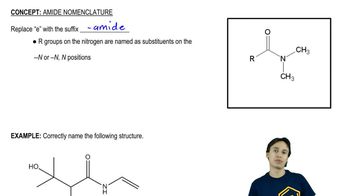
Amide Nomenclature

Hydrolysis of Amides

Amide hydrolysis is a chemical reaction where an amide is converted into a carboxylic acid and an amine or ammonia. This process typically requires acidic or basic conditions and heat. Recognizing this pathway is essential for predicting products formed from amides, as hydrolysis is a common transformation in organic chemistry.
추천 영상:
01:33
Amide Nomenclature

Reduction of Amides

Reduction of amides involves converting the amide group into an amine, often using reducing agents like lithium aluminum hydride (LiAlH4). This pathway is significant for synthesizing amines from amides, and understanding the conditions and mechanisms of reduction helps in predicting the final product of such reactions.
추천 영상:
01:33
Amide Nomenclature