Ch. 2 - General Chemistry Translated: Finding the Electrons
Mullins - Organic Chemistry: A Learner Centered Approach 1st Edition
Mullins1st EditionOrganic Chemistry: A Learner Centered ApproachISBN: 9780137566471당신이 사용하는 게 아니라요?교과서 변경
1장, 문제 75e

For the following partial structures, the σ bond is shown. Add the indicated number of π bonds, being sure to specify the orientation (that is, x, y, or z axis) of the p orbitals used.
(e) Partial molecular structure showing a carbon chain with a σ bond and notation for adding 2 π bonds.

검증된 단계별 안내
1
Step 1: Analyze the given structure. The image shows a carbon-carbon single bond (σ bond) with each carbon atom bonded to two hydrogen atoms. The problem asks to add one π bond to the structure.
Step 2: Recall that a π bond is formed by the sideways overlap of p orbitals. For a π bond to exist, each carbon atom must have an unhybridized p orbital available. This typically occurs when the carbon atoms are sp2 hybridized.
Step 3: Adjust the hybridization of the carbon atoms from sp3 (as shown in the image) to sp2. This will leave one unhybridized p orbital on each carbon atom, which can overlap to form the π bond.
Step 4: Specify the orientation of the π bond. The unhybridized p orbitals on the carbon atoms will overlap in a plane perpendicular to the σ bond axis. If the σ bond lies along the x-axis, the π bond will be formed by p orbitals oriented along the y-axis or z-axis.
Step 5: Update the structure to include the π bond. The π bond will be represented as a double bond between the two carbon atoms, indicating the presence of both a σ bond and a π bond in the molecule.

비슷한 문제에 대한 검증된 영상 답변:

이 영상 해법은 위 문제에 도움이 된다고 튜터들이 추천한 것입니다.
도움이 되었나요?

주요 개념

질문에 올바르게 답하기 위해 반드시 이해해야 하는 핵심 개념들은 다음과 같습니다.

Pi Bonds

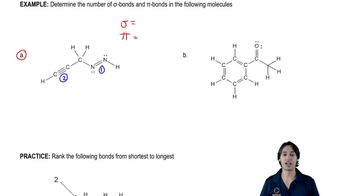
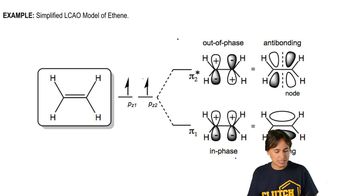
Pi bonds are a type of covalent bond formed by the sideways overlap of p orbitals. They occur in addition to sigma bonds in double and triple bonds, contributing to the overall stability and reactivity of molecules. Understanding the formation and orientation of pi bonds is crucial for predicting molecular geometry and reactivity.
추천 영상:
01:05
Sigma bonds and pi bonds

Orbital Orientation

The orientation of orbitals refers to the spatial arrangement of atomic orbitals in three-dimensional space. In the context of p orbitals, they can align along the x, y, or z axes, which affects how they overlap with other orbitals to form bonds. Specifying the orientation is essential for accurately depicting molecular structures and predicting their behavior.
추천 영상:
08:41
Review of Molecular Orbitals

Molecular Geometry

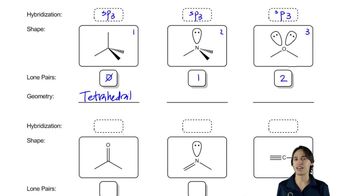
Molecular geometry describes the three-dimensional arrangement of atoms within a molecule. It is influenced by the types of bonds (sigma and pi) and the orientation of orbitals. Understanding molecular geometry is vital for predicting the physical and chemical properties of substances, including reactivity and polarity.
추천 영상:
07:44
Molecular Geometry Explained.