Ch. 2 - General Chemistry Translated: Finding the Electrons
Mullins - Organic Chemistry: A Learner Centered Approach 1st Edition
Mullins1st EditionOrganic Chemistry: A Learner Centered ApproachISBN: 9780137566471당신이 사용하는 게 아니라요?교과서 변경
1장, 문제 36a

For the molecules shown, indicate the direction of the dipole moment.
(a)

검증된 단계별 안내
1
Identify the polar bonds in the molecule by determining the electronegativity difference between the atoms in each bond. A bond is polar if the electronegativity difference is significant (generally greater than 0.4).
Determine the direction of each bond dipole moment. The dipole moment points from the less electronegative atom to the more electronegative atom. Use the periodic table to compare electronegativities.
Consider the molecular geometry to assess how the individual bond dipoles combine. If the molecule is symmetrical, the dipole moments may cancel out, resulting in no net dipole moment. If the molecule is asymmetrical, the dipole moments may add up to create a net dipole moment.
Draw the molecule's structure and use arrows to represent the direction of each bond dipole moment. The arrow should point toward the more electronegative atom, with a small cross at the tail to indicate the positive end.
Combine the bond dipoles vectorially to determine the overall direction of the molecular dipole moment. If the molecule has a net dipole moment, indicate its direction with a larger arrow pointing from the positive to the negative end of the molecule.

비슷한 문제에 대한 검증된 영상 답변:

이 영상 해법은 위 문제에 도움이 된다고 튜터들이 추천한 것입니다.
영상 길이:
4m
도움이 되었나요?

주요 개념

질문에 올바르게 답하기 위해 반드시 이해해야 하는 핵심 개념들은 다음과 같습니다.

Dipole Moment

The dipole moment is a vector quantity that represents the separation of positive and negative charges in a molecule. It is calculated as the product of the charge and the distance between the charges. A molecule with a dipole moment has a positive end and a negative end, indicating the direction in which the electron density is unevenly distributed.
추천 영상:
01:46
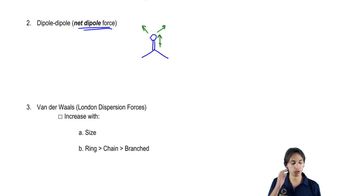
How dipole-dipole forces work.

Electronegativity

Electronegativity is a measure of an atom's ability to attract and hold onto electrons within a chemical bond. Atoms with higher electronegativity will pull electron density towards themselves, creating partial negative charges, while less electronegative atoms will have partial positive charges. Understanding electronegativity is crucial for predicting the direction of the dipole moment in a molecule.
추천 영상:
1:47
Electronegativity

Molecular Geometry

Molecular geometry refers to the three-dimensional arrangement of atoms in a molecule. The shape of a molecule influences how dipole moments add up; in symmetrical molecules, dipole moments may cancel out, resulting in a nonpolar molecule, while in asymmetrical molecules, they can reinforce each other, leading to a polar molecule. Analyzing molecular geometry is essential for determining the overall dipole moment direction.
추천 영상:
07:44
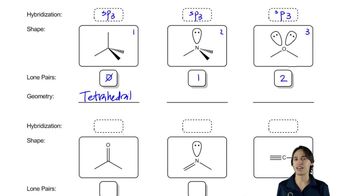
Molecular Geometry Explained.