Ch. 2 - General Chemistry Translated: Finding the Electrons
Mullins - Organic Chemistry: A Learner Centered Approach 1st Edition
Mullins1st EditionOrganic Chemistry: A Learner Centered ApproachISBN: 9780137566471당신이 사용하는 게 아니라요?교과서 변경
1장, 문제 1c

Give the electron configuration of the following elements.
(c) O

검증된 단계별 안내
1
Step 1: Understand the concept of electron configuration. Electron configuration describes the arrangement of electrons in an atom's orbitals, following the principles of the Aufbau principle, Pauli exclusion principle, and Hund's rule.
Step 2: Determine the atomic number of oxygen. Oxygen has an atomic number of 8, which means it has 8 electrons to arrange in its orbitals.
Step 3: Recall the order of orbital filling based on energy levels. The orbitals fill in the following sequence: 1s, 2s, 2p, 3s, 3p, etc., following the Aufbau principle.
Step 4: Begin filling the orbitals for oxygen. Start with the lowest energy orbital (1s) and proceed to higher energy orbitals. Use the maximum capacity of each orbital: 1s can hold 2 electrons, 2s can hold 2 electrons, and 2p can hold up to 6 electrons.
Step 5: Write the electron configuration for oxygen based on the filled orbitals. Oxygen's 8 electrons will be distributed as follows: 1s², 2s², 2p⁴. This notation indicates the number of electrons in each orbital.

비슷한 문제에 대한 검증된 영상 답변:

이 영상 해법은 위 문제에 도움이 된다고 튜터들이 추천한 것입니다.
영상 길이:
3m
도움이 되었나요?

주요 개념

질문에 올바르게 답하기 위해 반드시 이해해야 하는 핵심 개념들은 다음과 같습니다.

Electron Configuration

Electron configuration describes the distribution of electrons in an atom's orbitals. It follows the Aufbau principle, which states that electrons fill the lowest energy orbitals first, and is typically represented using the notation of subshells (s, p, d, f) and their respective electron counts. Understanding electron configuration is crucial for predicting an element's chemical properties and reactivity.
추천 영상:
02:14
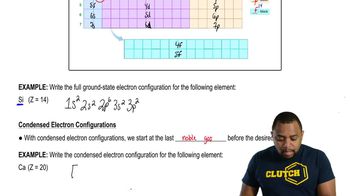
The Electron Configuration

Atomic Number

The atomic number of an element is the number of protons in its nucleus, which also equals the number of electrons in a neutral atom. For oxygen (O), the atomic number is 8, indicating that it has eight electrons. This fundamental property determines the element's identity and its position in the periodic table.
추천 영상:
01:44
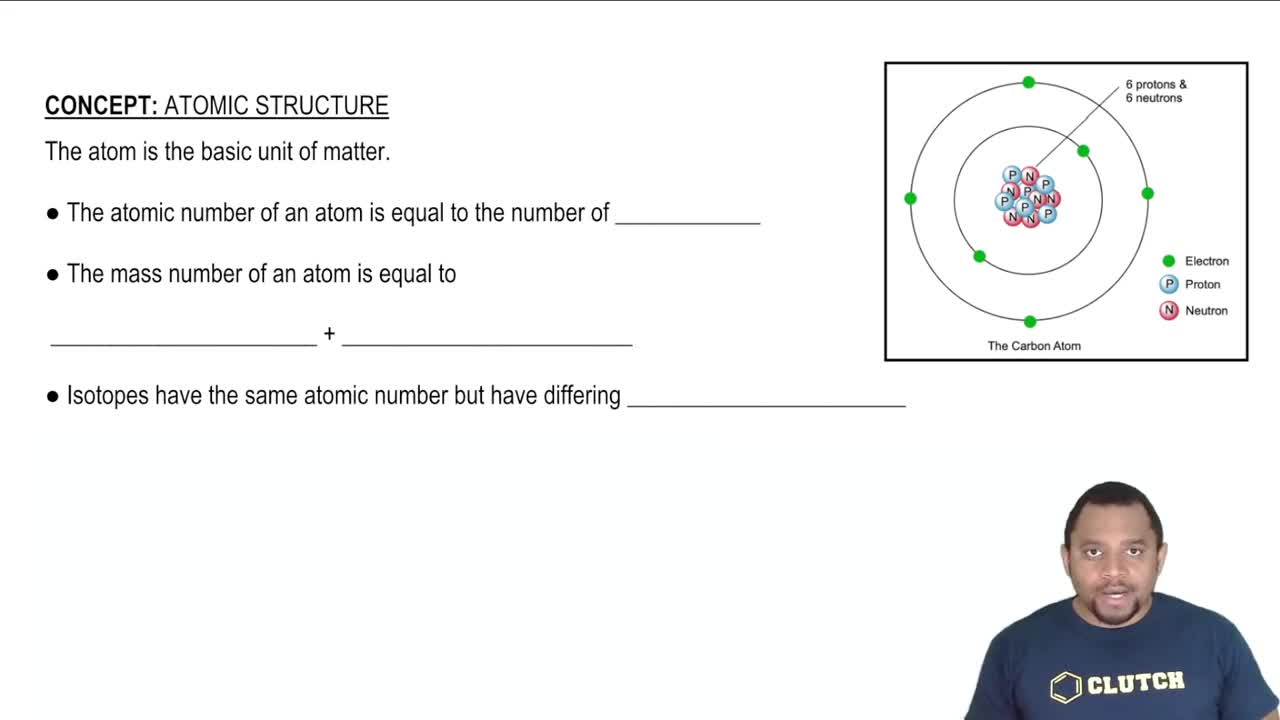
The difference between atomic numbers and atomic mass.

Orbital Filling Order

The order in which electrons fill atomic orbitals is governed by specific rules, including the Aufbau principle, Hund's rule, and the Pauli exclusion principle. The filling order typically follows the sequence of increasing energy levels, which can be remembered using the diagonal rule. For oxygen, the electron configuration is 1s² 2s² 2p⁴, reflecting this filling order.
추천 영상:
02:53
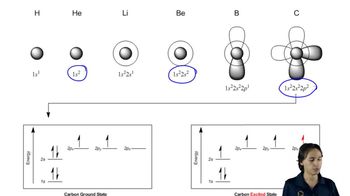
How carbon creates 4 partially-filled orbitals.