Ch. 2 - General Chemistry Translated: Finding the Electrons
Mullins - Organic Chemistry: A Learner Centered Approach 1st Edition
Mullins1st EditionOrganic Chemistry: A Learner Centered ApproachISBN: 9780137566471당신이 사용하는 게 아니라요?교과서 변경
1장, 문제 15d

How many electrons does an atom of each of the following elements need to gain to achieve a noble gas configuration? By gaining that many electrons, which noble gas configuration is achieved?
(d) Chlorine

검증된 단계별 안내
1
Determine the group number of chlorine in the periodic table. Chlorine is in Group 17 (halogens), which means it has 7 valence electrons.
Recall that a noble gas configuration corresponds to a full outer shell of electrons. For most elements, this means achieving 8 valence electrons (the octet rule).
Calculate how many electrons chlorine needs to gain to reach 8 valence electrons. Since chlorine has 7 valence electrons, it needs to gain 1 electron.
Identify the noble gas configuration achieved by gaining 1 electron. Chlorine (atomic number 17) will have 18 electrons after gaining 1 electron, which corresponds to the electron configuration of argon (atomic number 18).
Conclude that chlorine needs to gain 1 electron to achieve the noble gas configuration of argon.

비슷한 문제에 대한 검증된 영상 답변:

이 영상 해법은 위 문제에 도움이 된다고 튜터들이 추천한 것입니다.
영상 길이:
2m
도움이 되었나요?

주요 개념

질문에 올바르게 답하기 위해 반드시 이해해야 하는 핵심 개념들은 다음과 같습니다.

Noble Gas Configuration

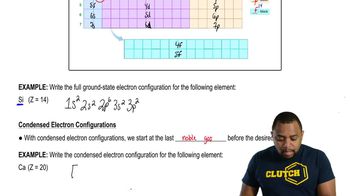
Noble gas configuration refers to the electron arrangement of noble gases, which have full outer electron shells, making them stable and unreactive. Atoms tend to gain, lose, or share electrons to achieve this stable configuration, typically resembling that of the nearest noble gas in the periodic table.
추천 영상:
02:14
The Electron Configuration

Electron Affinity

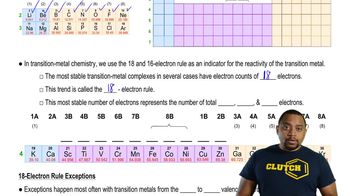
Electron affinity is the energy change that occurs when an atom gains an electron. Elements with high electron affinity, like chlorine, readily accept electrons to achieve a stable electron configuration, often resulting in the formation of negative ions (anions) that correspond to noble gas configurations.
추천 영상:
03:54
The 18 and 16 Electron Rule

Periodic Table Trends

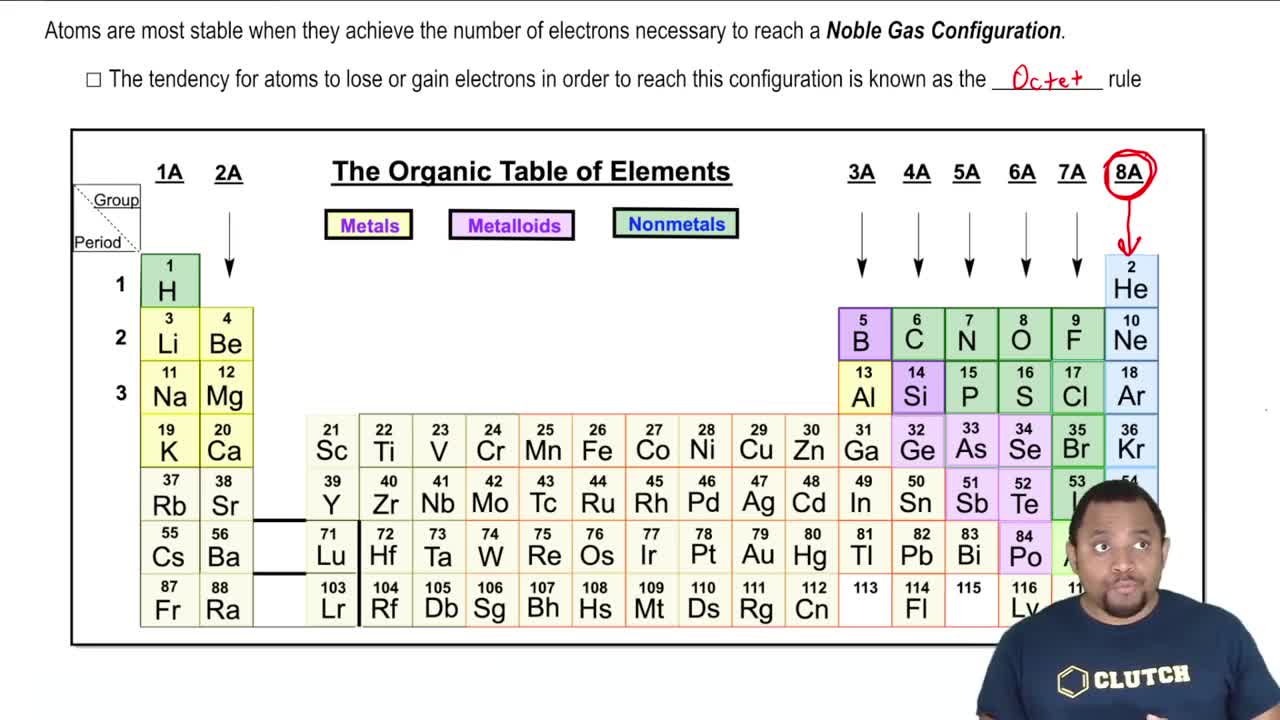
Periodic table trends refer to the predictable patterns observed in the properties of elements, such as electronegativity, ionization energy, and electron affinity. Understanding these trends helps in predicting how many electrons an element will gain or lose to achieve a noble gas configuration, particularly for nonmetals like chlorine.
추천 영상:
02:24
The most important parts of the periodic table for organic chemistry