Ch. 2 - General Chemistry Translated: Finding the Electrons
Mullins - Organic Chemistry: A Learner Centered Approach 1st Edition
Mullins1st EditionOrganic Chemistry: A Learner Centered ApproachISBN: 9780137566471당신이 사용하는 게 아니라요?교과서 변경
1장, 문제 40d

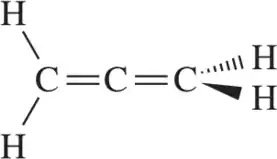
Use hybrid orbitals to draw the following molecules.
(d) Structural representation of a molecule with three carbon atoms connected by double bonds, with hydrogen atoms attached.

검증된 단계별 안내
1
Step 1: Understand the concept of hybrid orbitals. Hybrid orbitals are formed by the mixing of atomic orbitals on the same atom to create new orbitals that are better suited for bonding. Common types include sp, sp², and sp³ hybridization, which correspond to linear, trigonal planar, and tetrahedral geometries, respectively.
Step 2: Identify the central atom in the molecule and determine its steric number (the number of regions of electron density around the atom). The steric number is calculated as the sum of bonded atoms and lone pairs of electrons around the central atom.
Step 3: Based on the steric number, determine the type of hybridization for the central atom. For example, a steric number of 2 corresponds to sp hybridization, 3 corresponds to sp² hybridization, and 4 corresponds to sp³ hybridization.
Step 4: Draw the molecule using the determined hybrid orbitals. Represent the bonds using the appropriate geometry (e.g., linear for sp, trigonal planar for sp², tetrahedral for sp³). Include lone pairs if applicable.
Step 5: Label the hybrid orbitals on the central atom and ensure the drawing reflects the correct bond angles and molecular geometry. For example, sp hybrid orbitals form 180° bond angles, sp² form 120°, and sp³ form 109.5°.

비슷한 문제에 대한 검증된 영상 답변:

이 영상 해법은 위 문제에 도움이 된다고 튜터들이 추천한 것입니다.
영상 길이:
2m
도움이 되었나요?

주요 개념

질문에 올바르게 답하기 위해 반드시 이해해야 하는 핵심 개념들은 다음과 같습니다.

Hybridization

Hybridization is the process of combining atomic orbitals to form new hybrid orbitals that can accommodate the bonding requirements of atoms in a molecule. This concept is crucial for understanding molecular geometry and bonding, as it explains how atoms can form equivalent bonds in various geometries, such as tetrahedral, trigonal planar, or linear arrangements.
추천 영상:
10:43
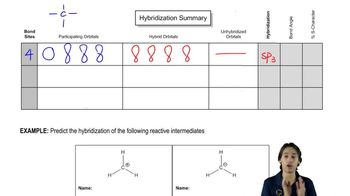
Using bond sites to predict hybridization

Molecular Geometry

Molecular geometry refers to the three-dimensional arrangement of atoms within a molecule. It is determined by the number of bonding pairs and lone pairs of electrons around the central atom, which influences the shape of the molecule. Understanding molecular geometry is essential for predicting the physical and chemical properties of substances.
추천 영상:
07:44
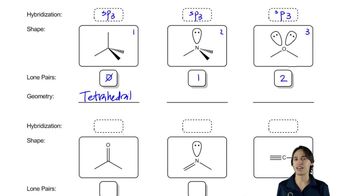
Molecular Geometry Explained.

Orbital Diagrams

Orbital diagrams visually represent the distribution of electrons in atomic and hybrid orbitals. They help illustrate how hybrid orbitals are formed and how they overlap to create bonds between atoms. By drawing these diagrams, one can better understand the bonding interactions and the resulting molecular structure.
추천 영상:
04:39
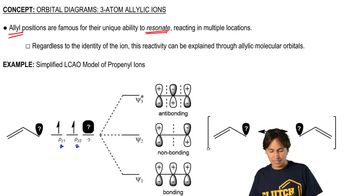
Orbital Diagram