Ch. 21 - Conjugated Systems 1: Stability and Addition Reactions
Mullins - Organic Chemistry: A Learner Centered Approach 1st Edition
Mullins1st EditionOrganic Chemistry: A Learner Centered ApproachISBN: 9780137566471당신이 사용하는 게 아니라요?교과서 변경
20장, 문제 2c

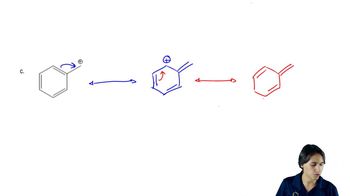
Draw all possible resonance structures for the reactive intermediates shown.
(c) Chemical structure diagram showing a benzene ring with a reactive intermediate and arrows indicating resonance structures.

검증된 단계별 안내
1
Identify the reactive intermediate shown in the image. The structure contains a benzene ring and a benzylic radical (a single unpaired electron) at the benzylic position. This radical is highly stabilized by resonance with the aromatic ring.
Begin by drawing the first resonance structure. Move one of the π-electrons from the benzene ring to form a double bond between the benzylic carbon and the adjacent carbon in the ring. The unpaired electron will now be located on the carbon in the ring where the π-electrons were removed.
Draw the second resonance structure. Move the π-electrons from the next double bond in the benzene ring to form a new double bond adjacent to the benzylic carbon. The unpaired electron will shift to the next carbon in the ring.
Continue the process to draw the third resonance structure. Move the π-electrons from the next double bond in the benzene ring to form a new double bond adjacent to the benzylic carbon. The unpaired electron will now be located on the final carbon in the ring.
Verify all resonance structures. Ensure that the aromaticity of the benzene ring is preserved and that the unpaired electron is delocalized across the ring, stabilizing the benzylic radical through resonance.

비슷한 문제에 대한 검증된 영상 답변:

이 영상 해법은 위 문제에 도움이 된다고 튜터들이 추천한 것입니다.
도움이 되었나요?

주요 개념

질문에 올바르게 답하기 위해 반드시 이해해야 하는 핵심 개념들은 다음과 같습니다.

Resonance Structures

Resonance structures are different Lewis structures for the same molecule that depict the same arrangement of atoms but differ in the distribution of electrons. These structures help illustrate the delocalization of electrons within a molecule, which can stabilize reactive intermediates. Understanding resonance is crucial for predicting the reactivity and stability of organic compounds.
추천 영상:
03:04
Drawing Resonance Structures

Reactive Intermediates

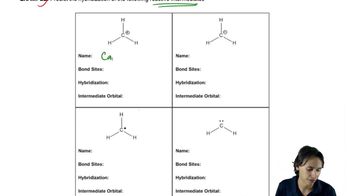
Reactive intermediates are transient species that form during the course of a chemical reaction and are typically unstable. Common types include carbocations, carbanions, and free radicals. Analyzing these intermediates is essential for understanding reaction mechanisms and predicting the outcome of organic reactions.
추천 영상:
02:47
Introduction to the reactive intermediates.

Electron Delocalization

Electron delocalization refers to the distribution of electrons across multiple atoms in a molecule, rather than being localized between two atoms. This phenomenon is a key feature of resonance and contributes to the stability of reactive intermediates. Recognizing how electrons can be shared among different atoms is vital for drawing accurate resonance structures.
추천 영상:
03:54
The 18 and 16 Electron Rule