Ch. 22 - Conjugated Systems 2: Pericyclic Reactions
Mullins - Organic Chemistry: A Learner Centered Approach 1st Edition
Mullins1st EditionOrganic Chemistry: A Learner Centered ApproachISBN: 9780137566471당신이 사용하는 게 아니라요?교과서 변경
21장, 문제 2

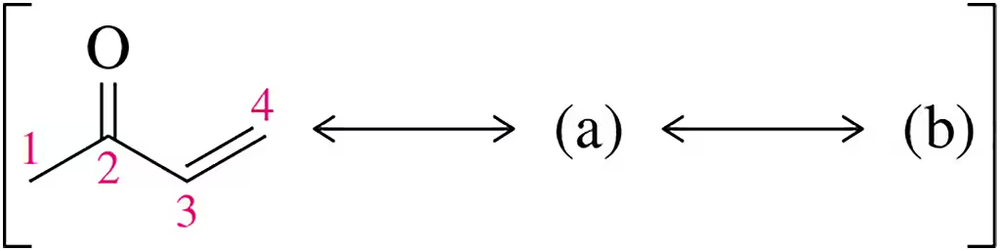
Draw two important resonance structures involving the C―O π bond for the molecule shown. To which carbons would you expect a nucleophile to add?
Resonance structures of a molecule with a C―O π bond, labeled with carbon numbers 1 to 4, showing electron movement.

검증된 단계별 안내
1
Step 1: Identify the functional groups in the molecule. The molecule contains a carbonyl group (C=O) at position 2 and a conjugated double bond system involving carbons 3 and 4.
Step 2: Recognize the resonance possibilities. The carbonyl group can delocalize its π electrons, and the conjugated system allows for resonance structures to be drawn.
Step 3: Draw the first resonance structure. Move the π electrons from the C=O bond to the oxygen atom, creating a negative charge on oxygen and a positive charge on carbon 2. This results in a resonance structure where carbon 2 is electrophilic.
Step 4: Draw the second resonance structure. Move the π electrons from the double bond between carbons 3 and 4 toward carbon 2. This creates a new double bond between carbons 2 and 3, while carbon 4 gains a positive charge.
Step 5: Determine nucleophilic attack sites. Based on the resonance structures, nucleophiles are likely to attack carbon 2 (due to its positive charge in the first resonance structure) and carbon 4 (due to its positive charge in the second resonance structure).

비슷한 문제에 대한 검증된 영상 답변:

이 영상 해법은 위 문제에 도움이 된다고 튜터들이 추천한 것입니다.
도움이 되었나요?

주요 개념

질문에 올바르게 답하기 위해 반드시 이해해야 하는 핵심 개념들은 다음과 같습니다.

Resonance Structures

Resonance structures are different ways of drawing the same molecule that illustrate the delocalization of electrons. They help in understanding the actual electronic structure of a molecule, which is a hybrid of all possible resonance forms. In the context of the C―O π bond, drawing resonance structures can show how electron density shifts, affecting reactivity and stability.
추천 영상:
03:04
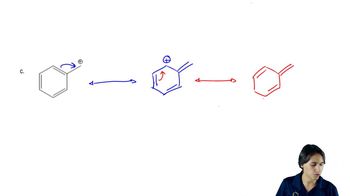
Drawing Resonance Structures

Nucleophilicity

Nucleophilicity refers to the ability of a nucleophile to donate an electron pair to an electrophile, forming a new bond. In the given molecule, nucleophiles are likely to attack the carbon atoms adjacent to the C―O π bond, particularly where positive charge density is indicated in resonance structures. Understanding nucleophilicity is crucial for predicting reaction pathways in organic chemistry.
추천 영상:
08:27
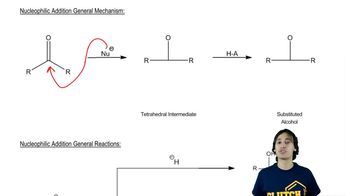
Nucleophilic Addition

Electrophilic Sites

Electrophilic sites are locations in a molecule where electron density is low, making them susceptible to attack by nucleophiles. In the context of the provided molecule, the resonance structures can help identify which carbon atoms (such as carbons 2 and 3) are more electrophilic due to the presence of the C―O π bond. Recognizing these sites is essential for understanding reaction mechanisms.
추천 영상:
03:
Nucleophile or Electrophile